We’ve been following the Paul Rothrock contract saga all year, watching it unfold from hopeful spring negotiations through a championship summer and into what now appears to be something of an impasse. The Sounders have reportedly made what they consider their best offer. Rothrock, right or wrong, believes he’s worth more than what’s on the table. With the two sides seemingly stuck, I found myself wondering: what should Paul Rothrock actually get paid? Rather than speculate based on vibes and gut feelings, I decided to take a data-driven approach to answering that question.
Using machine-learning models trained on three seasons of MLS salary and performance data, I built a system to estimate fair market value for players based on their statistical profiles and comparable peers. The methodology isn’t perfect — no model can capture everything that goes into a contract negotiation — but it provides a useful framework for understanding what the market says Rothrock is worth.
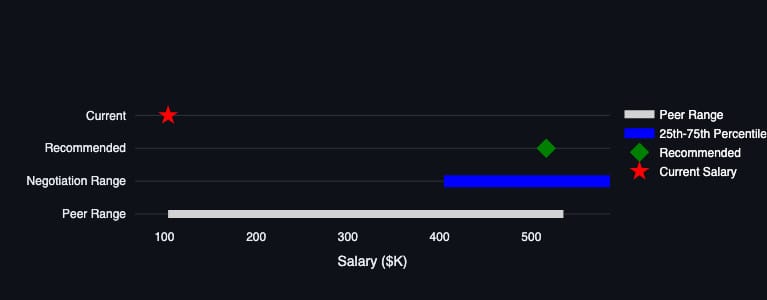
The TL;DR: $515,000 — backed by position-specific peer analysis and peer-reviewed MLS research — but let’s explain how we got there…
The Rothrock Story
Understanding Rothrock’s value requires understanding his journey, because context matters when you're evaluating a player who has had to earn every opportunity he’s ever received. Born and raised in Seattle’s Capitol Hill neighborhood, Rothrock spent most of his youth career with Seattle United, a partner club of the Sounders Academy. He led them to two Washington State Cup titles, two Far West Regional titles, and two appearances in the U.S. Youth Soccer national finals. In his U18 season, he joined the Sounders Academy proper, helping the squad to a third-place finish in the USSDA National Playoffs.
At Lakeside School, Rothrock was a two-time all-state player who tallied 43 career assists — numbers that earned him a spot at Notre Dame. But that didn’t go as planned. He barely played his freshman year, had limited appearances as a sophomore, and eventually transferred to Georgetown where he finally found his footing. In his first year with the Hoyas, Rothrock had four goals and seven assists. That included a goal in the National Championship game, helping Georgetown win its first title. Then COVID delayed his senior season, and he had to turn professional without the type of showcase opportunities most draft prospects rely on.
Toronto drafted him in the third round in 2021, but he spent two years mostly playing in USL League One with Toronto FC II, making just two MLS appearances on short-term loans. When he returned to Seattle in January 2023 to sign with Tacoma Defiance, it felt less like a homecoming and more like a last-chance audition. Through his first three games with Tacoma, though, he assisted four of the team’s six goals. He scored his first goal on April 30 against LA Galaxy II. The Sounders were suddenly paying attention.
 Tim Ostlund-Foss
What happened next has become Sounders lore. On April 26, 2023, Rothrock joined the first team on a short-term loan for a U.S. Open Cup match and scored on his club debut. In May, he signed a second short-term loan and scored again in another Open Cup match against LA Galaxy. Then came his MLS debut on May 13: a game-winner in the 1-0 victory over Houston Dynamo. He became the first Sounder to score in each of his first three appearances, and the first player in club history to score while on a short-term loan. By August, he had his first-team contract.
That initial deal only guaranteed him through the 2023 season at league minimum, with club options for 2024 and 2025. The Sounders exercised those options after his breakout 2024 campaign — eight goals and two assists —but couldn’t come to terms on a long-term extension. So Rothrock entered 2025 in a contract year, once again needing to prove himself. “Staying focused on the day-to-day stuff is the most important, not getting too ahead of myself,” he said in February. “I have to earn it again.”
Earn it he did. The 26-year-old appeared in a team-high 44 of 46 games across all competitions this season, starting 33 of them including 27 in league play. He logged 2,163 minutes, proof he can handle a full MLS workload. He contributed five goals across all competitions, including the game-winner against Real Salt Lake in October that kept the Sounders’ playoff hopes alive. Most importantly, he was a key contributor to Seattle’s Leagues Cup championship run, where Brian Schmetzer famously compared him to Messi (tongue firmly in cheek, but still). The Sounders even ran a promotion offering to swap Messi jerseys for Rothrock kits.
Now he enters free agency as a proven commodity, a versatile winger who can play RM, LW, or RW, has championship experience, and is entering the prime years of his career. His current $104,000 salary is laughably below market value. Everyone agrees he deserves a raise. The question is how much?
The Methodology: Machine Learning Meets MLS
To estimate Rothrock’s fair market value, I used two complementary machine-learning approaches trained on data from 858 unique MLS players across the 2023, 2024, and 2025 seasons. The performance statistics come from FBref, salary data from the MLS Players Association database, and positional information from EA Sports FC 25. Let me walk through each approach and what it tells us.
Random Forest Classification: What Tier Does He Belong In?
The first model is a Random Forest classifier designed to predict what roster designation a player should receive based on their performance metrics. MLS roster rules create natural salary tiers, Designated Players at the top, then TAM (Targeted Allocation Money) players, then what I’ll call “Standard” roster spots. The model analyzes a player’s statistical profile and predicts which tier they belong in.
For Rothrock, the model examined his shooting efficiency and expected goals (xG), passing accuracy and progression metrics, dribbling success rate and ball carries into the final third, defensive contributions including pressures and tackles, and shot-creating and goal-creating actions. After crunching those numbers against the broader population of MLS players, the model predicts Rothrock as a Standard roster player with 81% confidence at an R Squared value of 0.77.
That might sound underwhelming at first glance, but the nuance matters. Rothrock sits in the upper tier of Standard players, just below the TAM threshold. He’s not a Designated Player-caliber talent, his nearest statistical comp in that regard is Cristian Espinoza. Nor does he quite breach the thresholds for a TAM player, where his nearest statistical peer is Alonso Martinez of NYCFC. But he’s clearly above replacement level of coming off the bench. This classification helps establish a salary ceiling: Rothrock shouldn't command TAM-level money (roughly $750,000+), but he should be paid at the upper end of the Standard range.
K-Nearest Neighbors: Position-Specific Peer Comparison
The second approach uses a K-Nearest Neighbors algorithm to identify the players most statistically similar to Rothrock based on per-90 performance metrics. Rather than trying to classify him into a tier, this model asks: “Which players in MLS produce similar numbers, and what do they get paid?”
Critically, I ran this analysis twice — first with a broad midfielder comparison group, then with a position-specific approach. The difference was substantial and illustrates why granular positional analysis matters.
Initial Approach (Broad MF Group): The first pass compared Rothrock to all midfielders — CMs, CDMs, CAMs, RMs, and LMs — using generic midfielder features. This returned peers like Ian Harkes and Alonso Coello (both central midfielders) and produced an estimated salary of $282,506. But this methodology has a fundamental flaw: it’s comparing a winger to defensive midfielders who focus on tackles and interceptions rather than chance creation and progressive carries.
Refined Approach (Granular RM Position): The second pass compared Rothrock only to Right Midfielders using RM-specific features that capture what wide players actually do: assists per 90, expected assisted goals (xAG), progressive carries (PrgC), progressive passes (PrgP), dribble success rate (Succ%), crosses into the penalty area (CrsPA), shot-creating actions per 90 (SCA90), and key passes (KP). This is a fundamentally different skill set than what you’d evaluate for a CDM.
The position-specific approach returned a completely different and far more appropriate peer group:
The position-specific analysis produced a 43% higher valuation — $406,000 versus $282,506. Wide midfielders and wingers who create chances, deliver crosses, and carry the ball into dangerous areas command higher salaries than central midfielders in similar roster designation tiers. By comparing Rothrock to players who actually do what he does, we get a much more accurate picture of his market value.
The peer group now includes players like Jared Stroud, Mohamed Farsi, Wikelman Carmona, and Alex Muyl , all primarily right-sided midfielders with similar statistical profiles in chance creation, progressive play, and wide attacking contributions. This is who Rothrock should be compared to, not box-to-box midfielders or defensive pivots.