As we enter the final full year of the long-held two-conference system in Major League Soccer we’ve got to admit a sort of mass incredulousness has afflicted the opposing fanbases. Eastern Conference lifers have always and will always give a short shrift to the time-zone past their bedtime, Don Draper’s “I don’t think about you at al” to the Western Conference diehards as Pete Campbell in the elevator. We Petes have to accept that East Coast bias is a fact of life and feel sorry for their lack of interest in some of the most thriving soccer markets our nation has to offer. As a long-time watcher of both conferences, I maintain they are different experiences with their own merits and now bursting with 30 teams in the mix it’s been hard to see through the fog to cleanly articulate that and declare my favored coast’s bona fides.
futi (@futi.live) is the new kid on the block in the soccer data landscape and they are seeking to help us answer questions just like this. Their planned real-time scores app is seeking to add useful context above-and-beyond the raw counting numbers we find on Fotmob or the per-90 averages we might have seen on the now dearly-departed fbref advanced-stats tables. As a way of introducing these ideas and themselves to the scene, futi has recently been doing data releases of their own, focused on MLS, that highlight the ways their new models can help us understand the soccer that's happening on the field a bit better.
“Team Tendencies” and “Team Styles” are their latest contribution to the conversation and even with only three years of preliminary season-level tendency data to chew on we can absolutely find some interesting themes to help contrast the conferences and define what success looks like in MLS these days. I’m a “themes guy” so I love this stuff.
One of the new Team Tendency dimensions characterized by futi’s model is what they call the “Patient Progression” spectrum, focused on a team’s midfield handling of the ball. Measured with a value from -50 to 50, a tendency toward patient progression of the ball in midfield lies at one end of the scale (the positive end) while more direct progression of the ball through midfield at the other (the negative end). They define the scale as: “Patient Progression - Direct Progression: Intricate possession or faster, more aggressive play in the middle phase of possession?” Any longtime watcher of the Rave Green will admit their team are the poster boys for Patient Progression and futi’s model heartily agrees. Sounders have in fact been startlingly consistent in how the model measures this aspect of their playstyle over the years. Jake did a fantastic deep-dive on “Schmetzer Ball” through the lens of futi’s model earlier this week that I highly recommend.
One early theme to emerge from looking at this data is that while Sounders have been steadily in this lane, in just three seasons, the Sounders’ own level of emphasis on this has moved from being a near outlier in both the league and the conference to nearly half of the teams in the West shifting past the Sounders toward an even more patient side of the spectrum. I don’t think I’d clocked this change was happening.
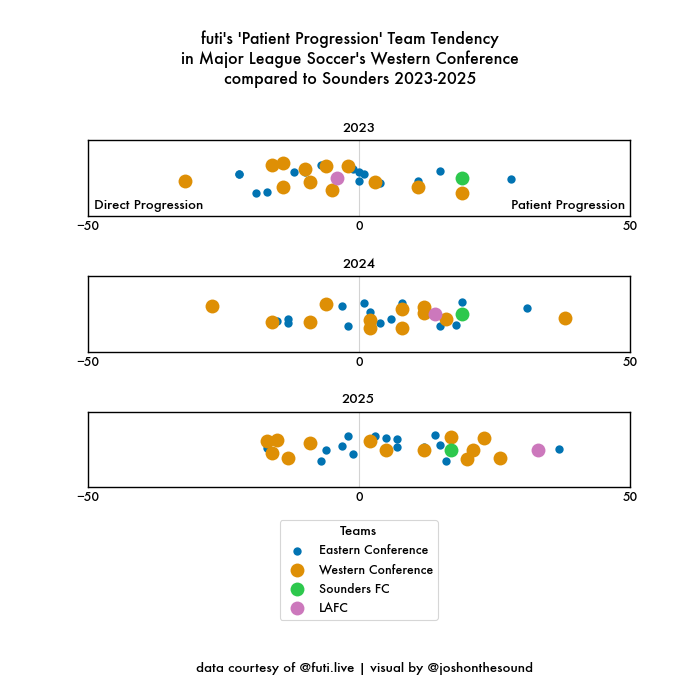
We can see the Eastern Conference has also experienced this same shift in style but not to the degree that the Western Conference has and is continuing to experience. On futi’s Team Styles Panel, which brings all eight of the tendencies together into one of four cohesive playing styles, “Control and Regroup” is identified as the dominant style in MLS in both conferences with two-thirds of the 30 teams fitting into that category (10 in each conference).
The Galaxy’s monster 2024 home season led by Riqui Puig and the subsequent MLS Cup win without him was built around perhaps the strongest lean-in to a controlled progression style that we’ve seen in recent years with a heavy emphasis on Patient Buildup, Patient Progression and maintaining Control as represented by futi's new “Chaos” team-tendency dimension. On the other end of the spectrum from Chaos, that is to say “jump ball” conditions where both teams are vying for the ball, is a tendency toward Control and the Galaxy’s value in 2024 was tilted in that direction more than any other team in the three-year dataset.