INGLEWOOD, Calif. – Mehdi Taremi and Mohammad Mohebi wanted to be heard. To be understood.
“It’s a bad situation,” said Taremi, the Iran national team’s star striker, “and we’re just tired of the situation, because from two months ago, last month, we have a lot of problems, you know? It’s so bad, and it affects our team, and we just want the peace, which is the center of FIFA – peace, joy and the best things.
“Everything is like a disaster, actually, for us.”
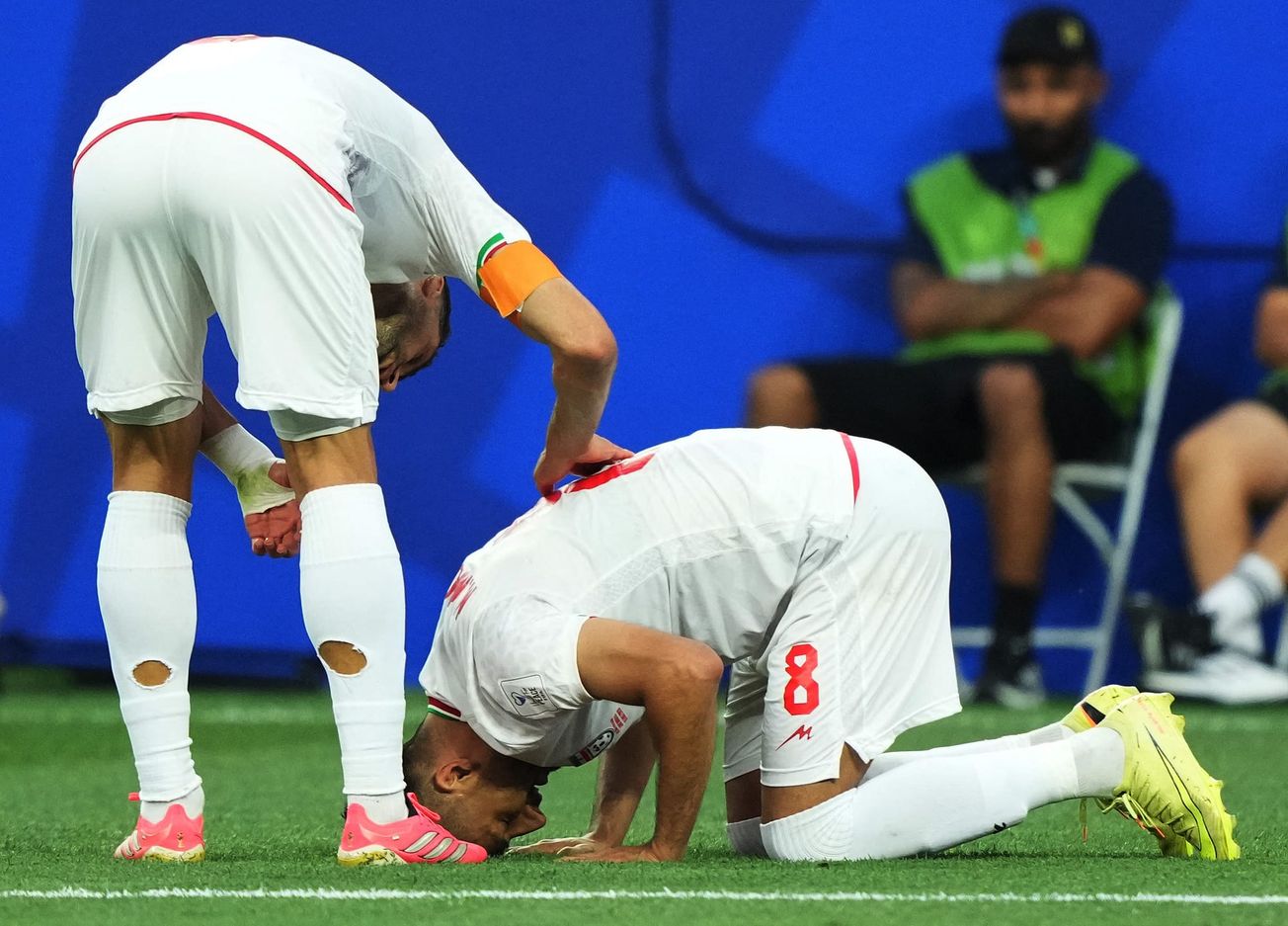
No. 2 on Iran’s all-time goalscoring list, Taremi is probably the most prominent player on the current squad. He did not have to linger in the postgame mixed zone, deep inside the stadium where he, his teammates and their counterparts from New Zealand had just produced the most gripping game of the 2026 World Cup so far, a vibrant 2–2 draw in front of a feverish crowd of more than 70,000. Nor did Mohebi, one of his side’s scorers on the day.
But they did, stepping down from the dais where they had just fielded questions, ignoring both a team staffer and a FIFA apparatchik as they sought to usher them away from the cameras and microphones and back to the locker room. Both answered a couple more, standing face to face with the reporters asking them, even a few that were wildly out of context, one Greek reporter asking Taremi about his club situation at Olympiacos.
When the duo finally walked away, it was on their terms, not their handlers’, the final act of a remarkable moment at the end of a stunning evening, one that reminded everyone present of the power of both this tournament and the sport itself – and just how egregiously FIFA has allowed geopolitics to blemish it this time.
“We must come here two days before the game. Yesterday’s trip [started] in the morning and we arrive at afternoon, and we go direct to the training,” lamented Mohebi. “We get tired, you know? I think it’s supposed to be, we came here two days before the game. This kind of thing, I think, it’s not a little bit fair, no? We need to get fair competition.”
Iran’s preparations have been drastically affected by the months-long war between their nation and the United States, with little sign of positive movement in the wake of this week’s ceasefire and supposedly imminent peace treaty. Team Melli’s ability to gear up for this massive event has been hamstrung on multiple fronts, most dramatically with a last-minute relocation of their base camp from Arizona to Tijuana, a consequence of unprecedented restrictions on their ability to enter U.S. territory to play their three group-stage matches, the third of which takes place in Seattle on June 26.
Taremi noted that FIFA president Gianni Infantino himself had visited the team in the locker room after Monday’s match, pledging to weigh in on their behalf, for whatever that’s worth.
“For sure, he wants to try to help us,” Taremi said. “But it’s about other things too. Everyone knows it.”
“You know where we are,” he said, referring to the host nation.
Originally U.S. authorities – who also denied visas to many members of the team’s staff, accusing them of trying to “sneak terrorists into the United States” – barred the three-time Asian champions from even staying overnight on American soil during the tournament. That’s been more recently amended to allow them to arrive one day before their matches, as they did on Sunday, training at the LA Galaxy’s Dignity Health Sports Park after a walkthrough on SoFi’s lush grass surface.
The repercussions of these suboptimal conditions were evident. Normally a fluid, ball-playing side with skillful players all over the pitch, Team Melli looked disjointed for long stretches – a factor of New Zealand’s surprisingly assertive approach, too – with their lack of warm-up friendlies also showing.
“I think we were in the air as much as we were on the ground,” head coach Amir Ghalenoei said in his postgame press conference. “They didn’t give us time to come two weeks early to adapt.
“Tonight is the most important issue for the next game, where we have to recover and be ready but we have to get on the plane, go back to Tijuana. This is a big problem that is bothering us in terms of the type of football itself.”
In that context, Iran’s tenacity to rally twice from deficits to earn a point against the Kiwis was that much more remarkable.
“The Iranian national team is perhaps the most oppressed team in the history of the various World Cups,” Ghalenoei declared. “The players gave more energy than they could and even though they weren’t in good physical condition and our compatibility wasn’t 100 percent, we were able to play an acceptable game and made two comebacks.
“Our late arrival and the fact that we are late in adapting has affected our players a lot. You see, four of our players were substituted due to cramps. We had to make all our substitutions for the sake of integrity, not for tactical issues.”
Probably no national team on earth has to walk a tightrope like Team Melli, who must compete under the keen scrutiny of a repressive theocratic government back home, yet are also seen by many in the enormous Iranian diaspora as stooges of that regime. Now they find themselves harassed by the sword-rattling superpower hosting the biggest occasion of their careers.

To read more about Team Melli and the Iranian diaspora who is supporting them, check out the new issue of IV: The Sounder at Heart magazine.
No one lives all this more profoundly than Taremi. This is a player who in March was spuriously reported to be leaving Olympiacos to join the Iranian military in the war against Israel and the US, his face photoshopped into combat fatigues by online pranksters – seemingly ludicrous, yet taken seriously enough that his agent had to issue public statements that it was all “absolutely fake news.”
He’s been interpreted as “a staunch supporter” of the country’s fundamentalist Islamic regime, yet also led displays of mourning for Mahsa Amini, the woman whose death in the custody of Iranian morality police sparked massive anti-government protests in 2022, and a shockingly bloody crackdown in response.
“I’m a football player. I’m not the politician guy, you know?” said Taremi with a weary smile when a journalist asked him what he would say to President Donald Trump if he had the chance. “We are here to play football, my friend.
“I can’t answer all the questions. But if you have something about the game today, I will answer – because it’s all about the problems, which we are tired to talk about,” he continued, plaintively calling on FIFA to ensure a more normal World Cup for him and his comrades. “If they help us, we much appreciate that. If no one helps us, it doesn’t matter. We just stay back to back, [get] behind each other, and we try our best to win.”
The country’s soccer federation hasn’t exactly distanced itself from politics, releasing an official World Cup hype video heavy with religious themes, explicit comparisons between Team Melli’s starting lineup and armed soldiers, vowing defiance “even if the entire world becomes our enemy.”
🇮🇷 Iran’s national football team just dropped their official World Cup video: “Our players have unwavering faith in Imam Hussein (PBUH).”
— Mario Nawfal (@MarioNawfal) June 10, 2026
They’re really going full crusade mode before kickoff...
TBH, I'm surprised, and a little bit disappointed they didn't do a Lego AI one… pic.twitter.com/PRKr0VOVbZ
Factor in the inescapable reality that the players’ public remarks – even their body language – can lead to harassment and other negative repercussions for their loved ones back home, and the individuals involved are stuck between a rock and a hard place.
If there’s a ray of hope, it’s in the visceral waves of support they received Monday, just down the road from "Tehrangeles," the Westside LA neighborhoods home to the world’s largest Iranian expatriate community. Despite some predictions that many of their own people would root against them, given the stark divisions this war has instigated among the diaspora, the crowd mostly jeered the anthem, then threw their voices behind the team.
“I want to mention our supporters in Los Angeles” said Taremi, “because it was incredible atmosphere during the game, whole 90 minutes, and we much appreciated that. It was like a home [game] for us. I hope they’re doing it next two games, same thing.”
Ghalenoei was even more effusive.
“This game and this atmosphere in the stadium, I think, were a turning point in the history of our football,” he said. “Today, there were many Iranians here with different attitudes and beliefs, but they all cheered their national team with their hearts. This, in my opinion, was the main win of this game, as about 70,000 people, most of whom were Iranians, cheered Iran with all their hearts.
“This could be a turning point in the history of our country.”