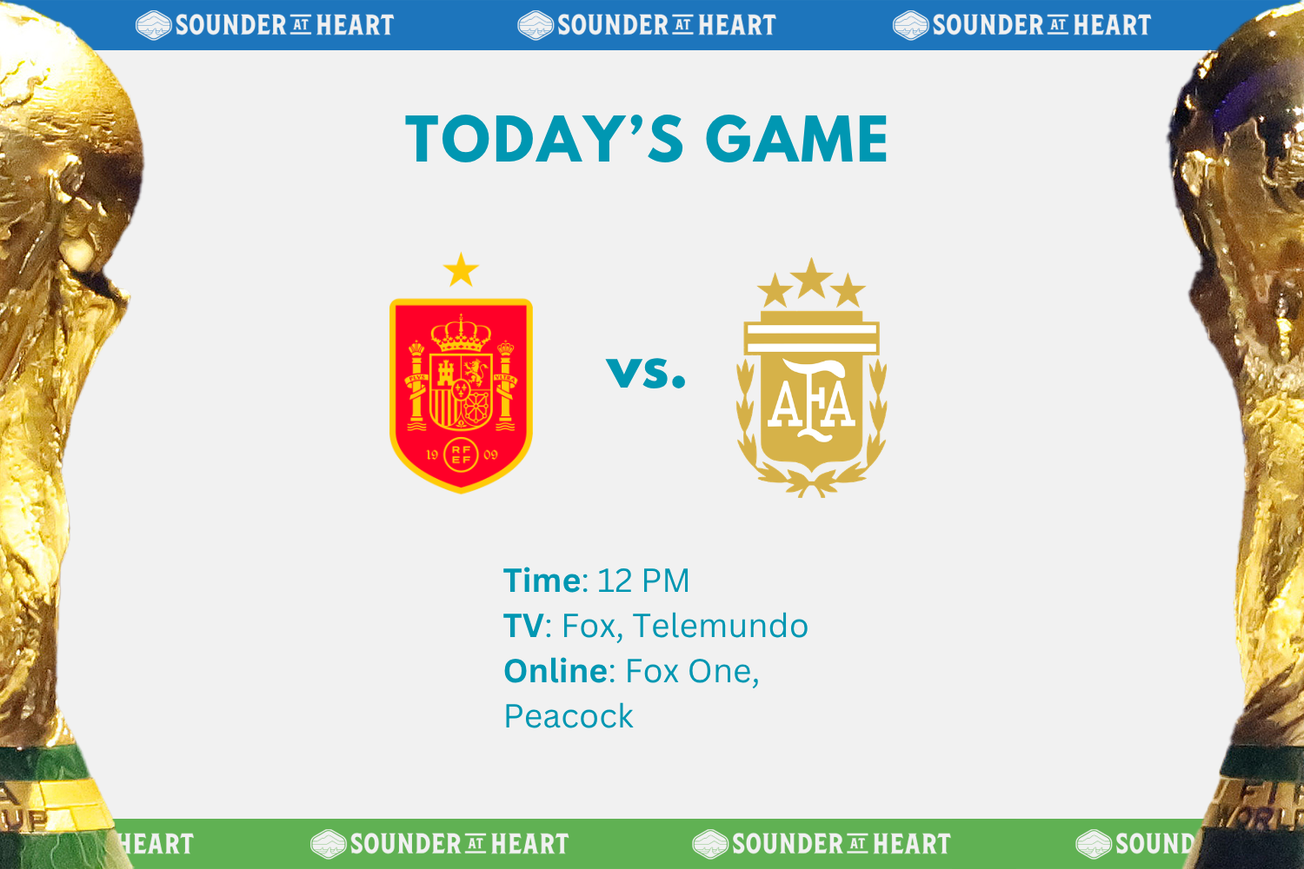
It's the biggest match in the entire world. It's the top two teams in the world. What else do you need?
Where to watch
Some of the big public spots have already been dismantled with no more games in Seattle, so here’s an update on which spots are still showing games:
- Brick Park: The Pioneer Square spot has turned into arguably the most popular viewing spot.
- Seattle Center Armory: Although the Mural Amphitheater stopped showing games, the indoor option is still available.
- Pacific Place: Although "Seattle Soccer House" has been dismantled, the games are still being shown at Pacific Place.
- Westlake Park: The outdoor viewing area hasn’t received the attention of some other spots but is very popular.
- Victory Hall: The facility across the street from T-Mobile Park will be hopping.
- KEXP Gathering Space: An indoor option that also allows you to watch the KEXP DJs at work.
- Hing Hay Park: The International District was a late-comer to the party but have proven to be a popular destination.
Today's games
Spain vs. Argenina
Time: 12 pm Pacific
Where: MetLife Stadium, East Rutherford, NJ
TV: Fox, Telemundo
Online: Fox One, Peacock

The new issue of IV: The Sounder at Heart magazine is now available for pre-order. Issue 2 will focus on Seattle’s role in the 2026 World Cup.
What’s interesting today?
The biggest World Cup ever comes down to this - Argentina vs. Spain.
It’s the top two teams in the world, the reigning South American and European champions, and the greatest player of all time in Lionel Messi taking on the next man up, Lamine Yamal.
This is the heavyweightest of heavyweight title fights between the countries that have arguably most defined the 21st century of international soccer.
The amazing thing is that while both Spain and Argentina feel like inevitable giants now, that was not the case for a very long time.
La Albiceleste have won three World Cups, but prior to Messi, they spent 80 they only times they climbed the mountaintop came in an eight-year window.
Otherwise, they were little brother to Brazil. A couple nice runs, but they needed help to win a World Cup, the thinking went. Most of the time, they went out in the quarterfinals. Between 1959 and 2021, they won Copa America just twice so they weren’t even a regional power.
Argentina were an upstart, a team that had a moment because of Diego Maradona, but not truly among the global powerhouses and even their conquests came under a cloud of controversy. Argentina’s 1978 World Cup was marred by allegations of match-fixing as their military junta government put extreme importance on success at the home-hosted event and their title in 1986 required the Hand of God to get out of the quarterfinals.
Spain, meanwhile, only made the final four at the World Cup for the third time ever this year. The last time, they won it all in 2010, but that was the only time they truly competed for the crown since 1950. In fact, they’ve missed the World Cup more times than they’ve made the semifinals.
Even the Euros weren’t fertile ground for Spain in the 20th century. They won the continental crown in 1964 and were runners up 20 years later, but those were their only trips to the semifinals in that competition too.
That these two countries, with their spotty success for much of international soccer’s history, can occupy the place in the global pantheon that they do speaks to how well the last 20 years have gone for both.
In Argentina’s case, that was entirely a product of Messi. In 2014, they made the final at the World Cup and then followed that up with matching runner up finishes at Copa America in each of the next two years. That’s when Messi retired, only to come back and finally break through with a continental crown in 2021, the World Cup a year later and another Copa crown in 2024.
Spain, meanwhile, won the Euros in 2008 and 2012, with a World Cup sandwiched between them. Led by the legendary Barcelona midfield of Sergio Busquets, Xavi Hernandez and Andres Iniesta, it was a golden era for Spanish soccer, unlike any they’d had before, but it didn’t end there. A semifinal finish at the Euros coming out of COVID and then conquering Europe in 2024 led them to this World Cup, where they are one win away from being crowned world champions again.
If you’d have told someone 20 years ago that Argentina and Spain would run the next two decades of international soccer, you’d have been laughed at.
The countries that wasted Juan Roman Riquelme, Gabriel Batistuta, Hernan Crespo, Fernando Hierro and Raul were suddenly not just going to start winning, but become the dominant teams of their continents and conquer the world? Ridiculous.
The idea that Brazil would spend more than a decade looking up at Argentina and Italy wouldn’t be able to hold a candle to Spain would be unfathomable.
And yet that’s what’s happened. Two countries who never lacked for talent, but could only put it together every once in a while, potentially under dubious circumstances, now aren’t just among the world’s elite; they are the elite.
The two best teams in the world. The class of South America against the kings of Europe. Argentina against Spain, with the World Cup and the title of the 21st century’s preeminent team on the line.
A few things I’ll be watching for in this match:
- Argentina can’t play from behind against Spain, can they? La Albiceleste have relied on last gasp goals the entire knockout stages, but it’s come exclusively against teams that have dropped deep against them and not tried to keep the ball, despite Argentina’s inability to win the ball back making them a prime candidate to kill the game with possession. Spain can certainly keep the ball, so a late-game comeback doesn’t seem likely to be in the cards. Argentina can’t afford to fall behind.
- It’s a battle of the old men in the middle of the pitch between Messi and Rodi. That’s probably not fair since Messi is nine years older than the Spaniard’s 30, but there have been concerns about Rodri’s athleticism because of his age and the torn ACL he suffered two years ago. Thus far, Rodri has found another gear whenever he’s needed it and been terrific at the base of the Spain midfield, but tracking Messi and the variety of runners that Argentina bring off of him will push him even further in a system that asks so much of him. If he excels yet again and Spain win, he’s going to have a good claim for the Golden Ball.
- The pitch at MetLife Stadium has been the worst in the tournament from the very beginning. It’s dried out easily and been extremely bumpy, with players comparing it to an artificial surface, but it hasn’t hosted a game in two weeks. Were they able to get the field in better shape?
- Will Spain free their fullbacks to get forward? Marc Cucurella has been charged with providing width from the left back spot since Spain don’t really have a left winger and Pedro Porro has scored two goals from the opposite side, but that could be dangerous against Messi. Will Luis de la Fuente fully trust his team’s possession and counterpressing to win the game far enough up the pitch that space behind the fullbacks isn’t a problem or will he be more conservative?