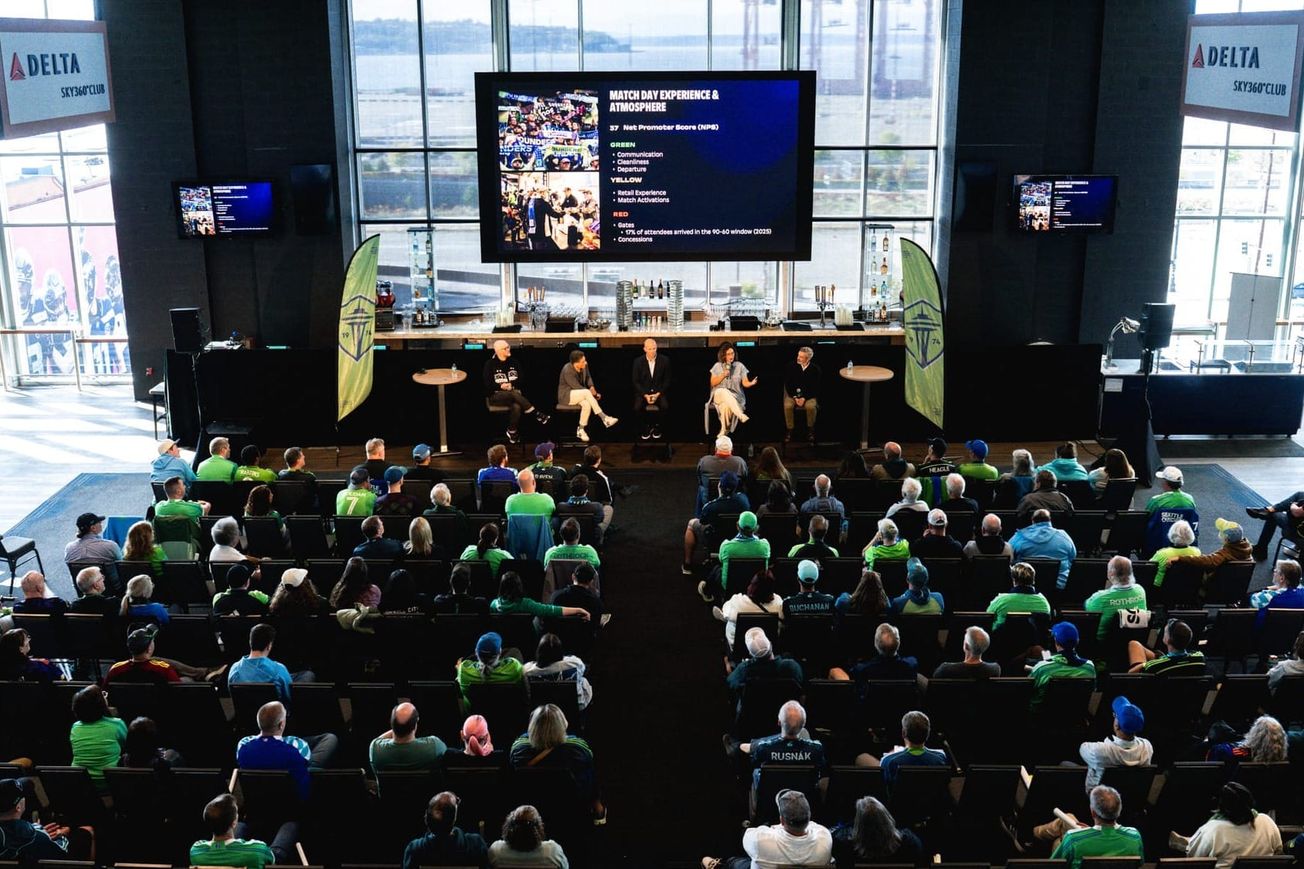
SEATTLE – Of all the things that the Seattle Sounders do that is unique to North American sports culture, the Annual Business Meeting might be the one that best represents the relationship with fans. While it’s not always the most illuminating, just the idea that club leaders are willing to share this much information with season-ticket holders and are willing to field questions on just about any subject is pretty special.
With the Sounders having just recently ended a 13-game winless run – by far the longest in the club’s storied history – and with rumors of an extremely unpopular move to Renton circulating, this year’s meeting promised to be a bit more interesting that what can often be a rather staid affair.
To the Sounders’ credit, they clearly understood that fans were not happy with the state of the club in a variety of ways and even scheduled the event before a match in order to more easily accommodate a larger-than-normal crowd. A few hundred people showed up in the West Club concourse and the Sounders spent the bulk of the meeting addressing fans’ concerns. In fact, they spent about 70 minutes of the two-hour event specifically answering questions.
As happy as I am to praise the Sounders’ leaders for being accountable, I’m not sure they did much to quiet most fans’ concerns. Fans who were upset with the direction of the club didn’t hear anything that is likely to change their minds. The unfortunate reality is that the Sounders don’t have the answers fans want to hear; a move to Renton is very much on the table, there’s not a big pot of money waiting to be spent on the roster and they are mostly relying on technology to improve the season-ticket experience.
If I were to score the meeting like a soccer game, I’d call it a 2–1 loss for the Sounders. It wasn’t the disaster it could have been, but I’m not sure fans are much happier than they were when they walked in.
Here were my main takeaways:
Move to Renton definitely on the table
Ever since former President of Business Operations Hugh Weber first told Sounder at Heart in 2023 that the Sounders were exploring the possibility of building a stadium near the Longacres training facility, it’s been my understanding that most inside the club have treated an eventual move almost as if it were a foregone conclusion. Curiously, at least to me, there has been almost no public discussion about it from the club. They’ve still never released any renderings – which I assume exist – and they certainly haven’t been making a public case for a move.
That's what made majority owner Adrian Hanauer's comments so interesting. While Hanauer specifically said the move is not a foregone conclusion, he at least started to make the case for why the Sounders are considering it.
Among Hanauer's complaints about Lumen Field are that neither the Sounders nor the Seattle Reign have dedicated locker rooms, that they don’t have access to all the revenue-generating ad inventory (like stadium naming rights and any fixed signage) and that they have limited control over scheduling.
"Our current situation here is untenable," Hanauer said about Lumen Field. "It may be not completely untenable for fans, but we have great examples of best practices of MLS teams playing in NFL stadiums (specifically Charlotte FC and Atlanta United, whose owners control the stadiums). We know what these soccer teams deserve in this building.”
That's some pretty strong language, and it was before he even got into the possibility that the new Seahawks owners might make future lease terms even worse than they are now. That lease expires in 2032, which means there’s basically a ticking clock on how long the Sounders have to come up with an alternative plan.
"We need that to change," Hanauer said. "There’s a world where that changes (and they can remain at Lumen). But if it doesn’t, we need a stadium of our own."
I suspect fans will find most of this rather compelling, but where they start to lose people is what the Sounders see as their best alternative.
Hanauer, half-jokingly, said that if anyone has a line on 12–14 acres of developable land in Seattle, they should get in touch. But he wasn’t exactly promising to spend his own time, energy and money finding a suitable location in Seattle.
Renton is probably not the ideal location, Hanauer admitted, but it is where the Sounders have access to land.
Hanauer said they’ve not finalized any plans for a Renton stadium, but they were likely looking at something around 25,000 seats that would be expandable. This got some scattered boos, I’ll note. The Sounders have never averaged less than 30,000 during 17 seasons at Lumen Field. Besides the expense of building bigger, that sort of target seems like a tacit acknowledgment there would be less demand in Renton.
The Sounders are gambling that even if some fans are turned off, they’d be able to attract new fans in part by being able to control everything about the stadium experience such as parking, concessions, atmosphere and signage. Hanauer noted that anyone who has attended an MLS match at a soccer-specific stadium can immediately see how those advantages improve the visitor experience. At one point when responding to frustration over concession prices and options, Hanauer quipped that they could have $5 beers at their future stadium (unlikely as that seems).
“It’s not a done deal by a long stretch, but it is something we need to explore," Hanauer said. "I get it. I know change sucks. I’m one of those people who believes change sucks. I know there’s a chance we’d lose some fans, but I don’t believe we’d lose all of you … I hope. We’ll have to convince you.”
About a year ago, Sounder at Heart ran a survey that asked – among other things – what people thought of a potential Renton stadium. About 50% of respondents said something along the lines of "I’ll never attend a match again" with another 23.5% saying they’d attend fewer. Those are stiff headwinds.
 Jeremiah Oshan
Sprint season is about assessment
As much time as was spent talking about a new stadium, the most recurring theme in the questions had to do with roster building. The Sounders have never been the highest-spending team, but we’ve repeatedly documented how they’ve slipped down that table in recent years. They are now, apparently, at the point where they are spend less discretionary funds – anything outside of the salary cap – than any other team.
The first step to addressing this was the trade for Dejan Joveljić, on whom they committed about $20 million between his transfer fee and salary.