My fellow Pacific Northwesterners, the time has come. The time when we emerge from our sun-drenched summer malaise and bask in the return of grey skies, light rain, and most dependably of all the Seattle Sounders breaking out of their mid-season slump to look like real playoff contenders.
It feels like it happens every year. The Sounders hit a rough patch, and the otherwise-steady train that is this club falls completely, exhaustingly off its tracks. Fingers are pointed, grievances are aired, debates rage.
And then they fix it. Maybe it’s a key signing, recoveries from injury, or just Brian Schmetzer looking at the calendar and realizing it’s October, but whatever it is, it sure feels like this is an annual pattern.
But is it? As a nerd who once had a column we called Sounder Data, I won’t stand for “feels”. I want numbers.
So, I got numbers. I pulled up every Sounders regular season result in the MLS era and wrote an algorithm to detect when, for how long, and how deeply the Sounders “slumped” each year.
A defined a “slump” as a period of five games or longer in which their recent form (PPG over the past five games) dipped below their season median. I constrained it to periods with a matchday at least 0.5 PPG below the median, ignoring one-game blips. This is relative to the rest of their season, not some absolute metric like “games below 1 PPG”, because that’s what I think of when I think of a “slump”: they underperformed their own standards, which is a moving target.
Anyway yes, the Sounders almost always hit an annual rough patch. Here’s the data:
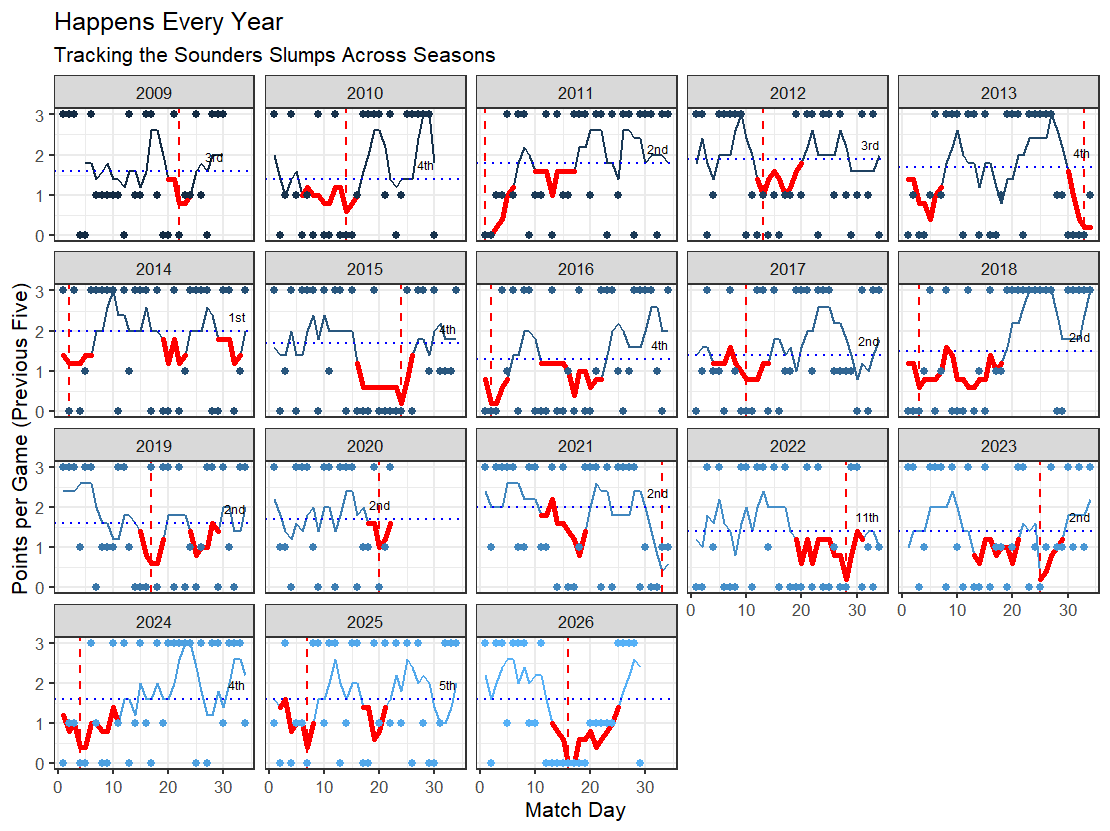
Here we see each season since 2009. Dots are games, the vertical axis is points, and the line is the five-game average. I’ve highlighted their slumps in red, according to the above definition.
You can see there’s a bad one almost every season. You can also see that they turn it around almost every season. I even printed the team’s finishing position in the Western Conference on each panel as a reminder.
For example, we may remember the year 2016. Things were bad. Not only did we have a deep, long summer slump, but we also kicked off the year with a bad start. By August, Sigi Schmid was fired, our savior Brian Schmetzer was in charge, and Nicolas Lodeiro was starting his first of many amazing seasons. The team turned it around, finished 4th in the West, and won their first MLS Cup.
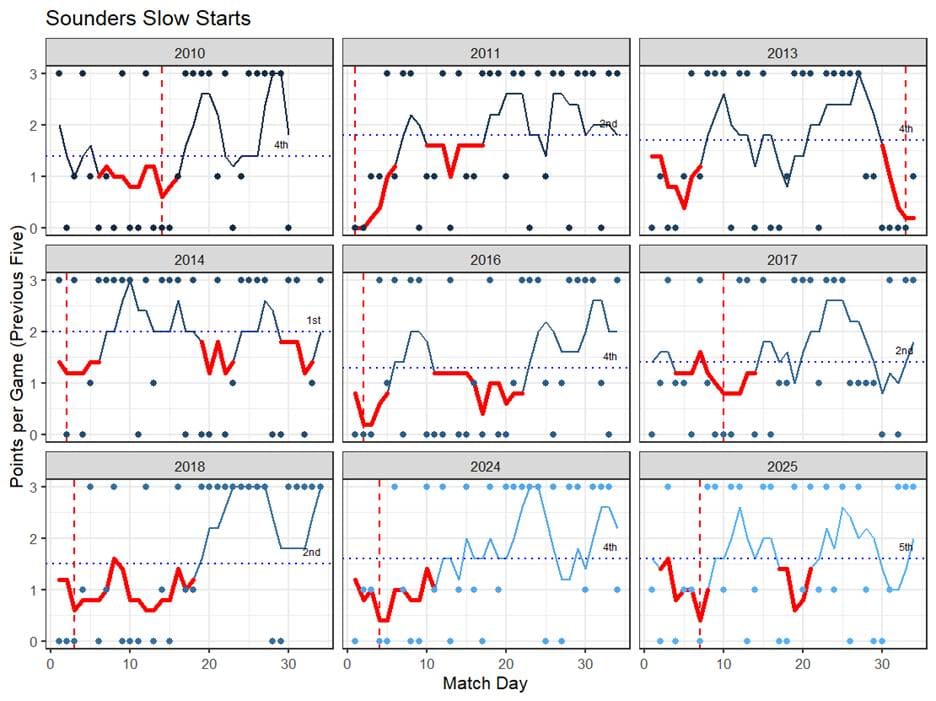
The 2016 season points out a different pattern too: the slow start. In fact, when you look closely at the above graphs, there’s really two kinds of slumpy seasons: “Slow starts” and “Summer slumps”. By my eye, seven seasons fall into the “slow start” category (2010, 2011, 2013, 2014, 2016, 2017, 2018 and 2024), though 2010 and 2014 were arguably not that bad (remember, we won our only Supporters’ Shield in 2014). On the other hand, 2018 was probably the roughest start, but we still finished 2nd in the West after an empirically historic turnaround, which you can see clearly. Here’s the slow starts:
Then there’s the classic summer slumps. This happened in all of 2009, 2012, 2015, 2016, 2019, 2021, 2022, 2023, 2025 and -extremely clearly- in 2026. This year was the undoubtedly worst slump we’ve ever had. For the first time, our five-game average bottomed out at zero PPG for multiple weeks. Here it is in all its morbid glory:
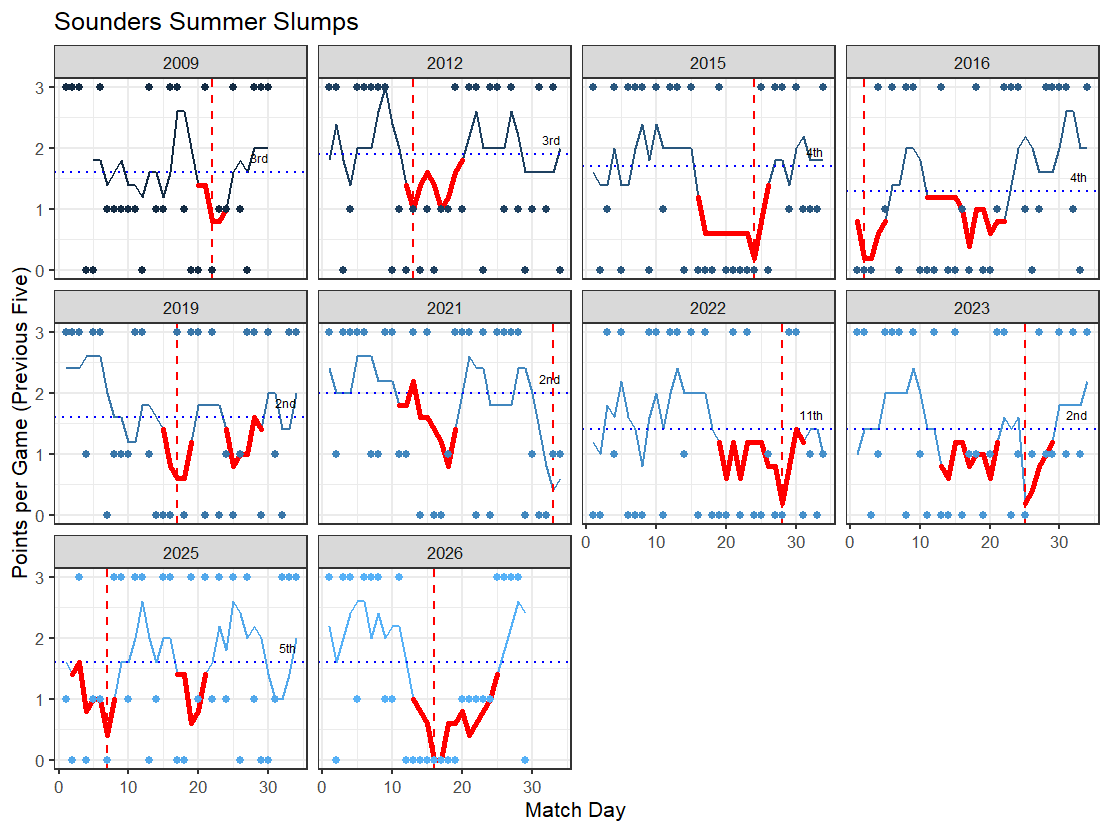
But again, nearly every one of these summer slumps (except 2022 when, as you might have heard, we won Concacaf) is followed by a remarkable resurgence and respectable final place in the standings.
There’s a couple of other oddities to speak of in all this too. Like 2020 (the Covid season) where we basically had no slump at all, and 2013 and 2021, which were the only late-season collapses we’ve ever experienced.
What I think is most noteworthy though is not just that the lows are predictable, but the highs are predictable too. The Sounders have almost always found a way to pull out of their annual slump, be it early- or mid-season.
The 2026 season isn’t over, and this week’s 1-0 loss to FC Dallas didn’t help, but you hardly need any data analysis at all to feel it happening again. After their track record, I think the question isn't will the Sounders finish strong this year, but how strong?