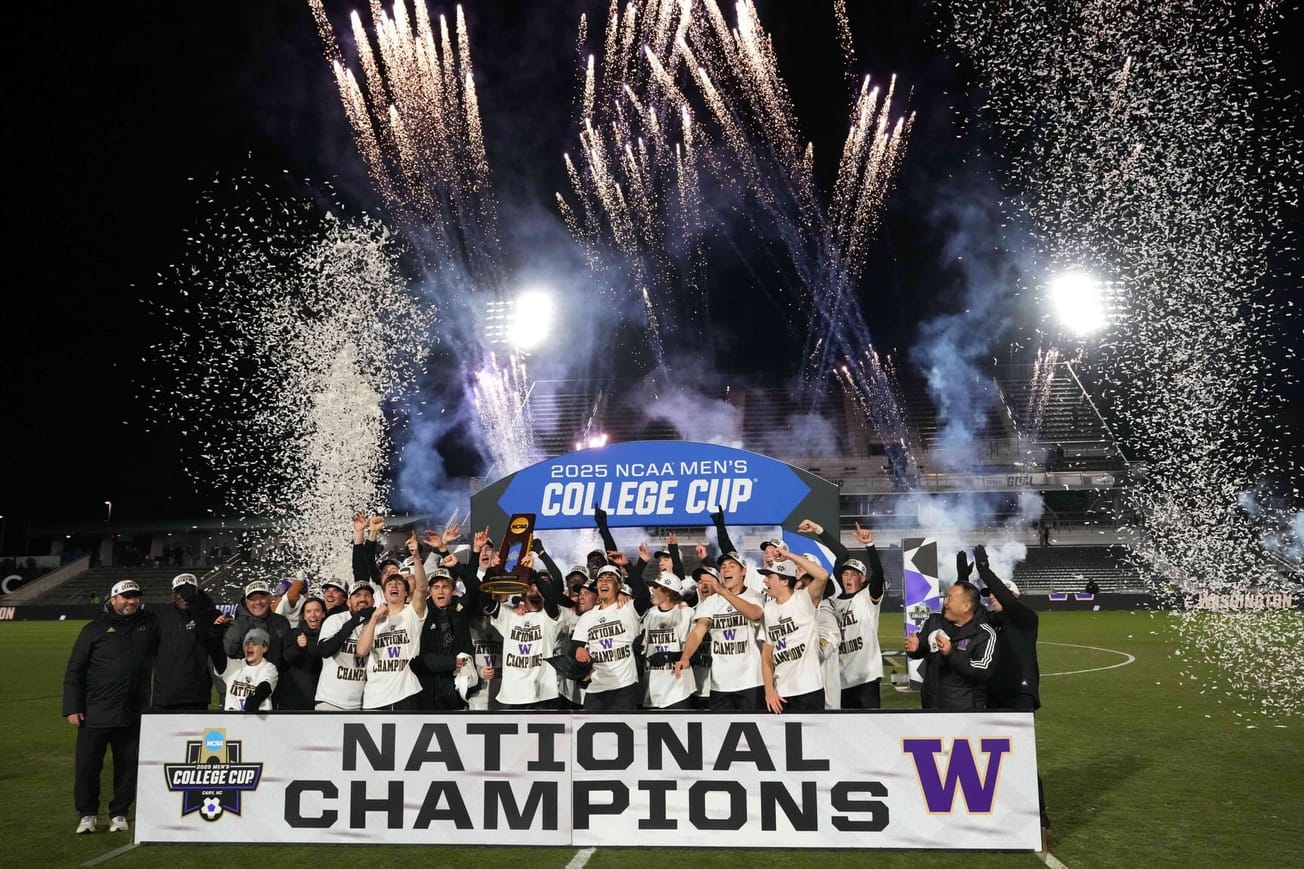
When Washington’s winner bulged the back of the net, it was as if it was wired with an electrical charge capable of instantly zapping purple-clad alumni across the continent and back through the ages.
Not only was it pandemonium on the Washington bench but also in the rec rooms of UW players and coaches and fans spanning seven decades. Stabbing his close range shot between post and N.C. State keeper, Harry Bertos finally, after 63 seasons, pushed the Huskies over the hump and into the elite circle of NCAA champions on Dec. 15.
Scattered across the Northwest and nation were some 600 former players and coaches, now fans, who were watching the national final on their phones and rec room screens. Up in Bellingham, the UW men’s soccer program’s first coach spontaneously defied gravity.
“We jumped up off our seats,” exclaimed Ron Jepson of his family’s reaction. It was a “momentous occasion,” added Jepson, the coach of UW’s first varsity team. An engineering graduate student from England, he was handed Washington’s reins in October 1962, when the nearest collegiate competition was in Victoria and Vancouver.
Euphoria in Carolina
While Jepson was 2,947 miles away from the drama in Cary, N.C., Marty Rood was in the house at WakeMed Soccer Park. Rood, who played under Mike Ryan in the early 1970s, had flown from Seattle on the morning of the match, arriving in Raleigh a couple hours before kickoff, to join the scores of UW traveling fans dwarfed by the 10,000 cheering the hometown Wolfpack.
Rood stood alongside other alums spanning the seven decades of Husky soccer and found himself hoarse from support and celebrations going long into the night.
“This win was more euphoric than any in my years of soccer,” shared Rood. “It just didn’t seem they would lose…they just never gave up. They were relentless!”
Much like the state’s past 13 collegiate champions at the Division II and NAIA levels, most of this Washington roster was homegrown. Seven of the starters and 10 of the 15 (19 in total) to see action at the College Cup finals hail from the state. That’s always been a hallmark of the Huskies (by comparison, N.C. State had 11 internationals and six in-state players).
Like Part of the Team
In his hometown of Tacoma, Danny Vaughn shed his mild-mannered, sports-watching persona for the nationally televised natty. “I jumped up from my couch, shouting, ‘It’s in!’” Vaughn graduated as the program’s scoring king before a five-year professional career. “That winning goal was a rush of pride and joy for all Huskies. For a moment, I felt like I was part of the team on the field.”
John Hamel (’85-88) of Seattle played midfield at Montlake. He and fellow teammates sensed something special earlier this season. “We felt that this team was carrying with it years of players and history, and while it was this specific team that won it, decades of Soccer Dawgs feel the pride of being part of the program.”
The first 30 seasons of UW soccer were blessed with some exceptional players and coaches but hamstrung by an administration choosing to operate such Olympic sports on the cheap: Part-time coaches, meager travel budgets, inadequate facilities and less than the full complement of scholarships.
During Hamel’s day, the Huskies were operating on a shoestring, compared to D2 Seattle Pacific and Portland, which siphoned off a significant number of top Puget Sound area players to become a D1 force. Santa Clara and UCLA would win NCAA titles with Seattle-area starters.
Old School Grit
Under seven part-time coaches, Washington still earned respect and seven NCAA tournament berths, despite the field being half the size of today’s 48-team bracket. Advancing in the tournament was another matter. Not until Dean Wurzberger was hired as the first full-time coach, in 1992, did UW win its first postseason game.
Jeff Koch (’87-88) recognized that the 2025 Huskies demonstrated tenacity, a quality which was integral in the program’s early years. “Today, (generally) I see grit lacking,” noted Koch. “(However) this staff and players reminded me of the old school, life-on-the-line attitude; good ol’ grit. It’s the toughest group I’ve seen in a long time.”
Eddie Henderson (’85-86, ’88-89), UW’s first All-American and U.S. youth international, is a member of that era’s lengthy alumni text chain. That text chain, said Hamel, “would blow up” after goals and wins during the tournament. As Bertos shed his jersey and sprinted the length of the field, Henderson was right there with him.
“He was having his moment, something we all dream about, winning the whole thing,” said Henderson. “I was happy for him, for Jamie (Clark, the head coach) and all the players. This was an accomplishment that many former players like me believed a Washington team was capable of,” he added, “and I’m glad I got to see it in my lifetime.”
Clark: You Can Count on It
Jamie Clark arrived in Seattle in 2011, and two years later No. 2-seeded Washington reached its first quarterfinal. By 2021, Clark had positioned the program as a perennial national power, advancing to a fourth quarterfinal in eight years – and punching a ticket to the College Cup for the first time. The Huskies, committing some fluke miscues early, fell to Clemson in the final.
Following that season, Dick Valore (’73-76) spoke with Clark and came away convinced that this was the man who could persevere and create the Huskies who would be kings. “He loved working with young players, and he knew the program was just hitting its stride,” Valore recalled. “He said something like, ‘We will win the NCAA title soon; you can count on it.’”
From defeat can come resolve. Once a victory away from virtually locking up the Big Ten regular season title, Washington dropped three games in a row and was in danger of missing the NCAAs altogether. Playing the tournament opener at longtime nemesis Oregon State, the Huskies trailed before getting a late equalizer and an amazingly acute Richie Aman winner deep into overtime.
Overcoming Obstacles
That was the first of six wins in a row, all on the road or in hostile environs. They drew strength from one another, from support back home and from their Montlake sisters, who were coping with the Nov. 6 death of teammate Mia Hamant. Both teams wore #ForMia orange ribbons over their hearts.
Alums such as Rick Blubaugh (’85-87) marveled at the team’s espírit de corps and embracing the power of putting the team above all else.
John Graves (’77-78, ’80-81) said a mental toughness, a steadfastness, enveloped the squad over a bumpy road. “They overcame every obstacle thrown at them,” said Graves. “We all know the battle is tough…but the struggle and the sacrifice make the victory sweet.”
“An NCAA tournament run of six straight wins after losing their previous three games demonstrates preparedness, skill and composure,” offered Jerome Rauen (’77-79). “What an incredible moment to put it all together. I am so proud.”
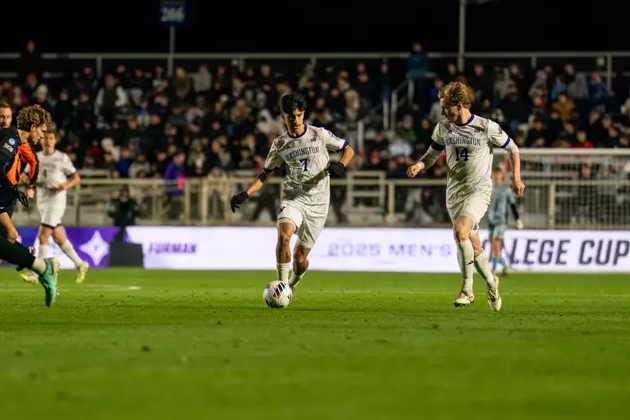
Since forming in 1962, nothing has come easily for the Huskies. For the first 155 minutes of the College Cup, it was a relative breeze in building leads over Furman and N.C. State. Then came the Wolfpack fight back to force overtime. Even the Bertos winner could not be fully celebrated until after a lengthy VAR check.
Ready for Their Moment
From his armchair in Kirkland, former UW coach Frank Gallo (’80-82) perceived Clark & Co. were steeled for such adversity. Rather than slump, the Huskies shifted into overdrive. On Whidbey Island, Paul Mendes (’73-76) also detected that resolve. “They were not in the least bit intimidated,” he observed. “They believed, and they were ready for the moment.”
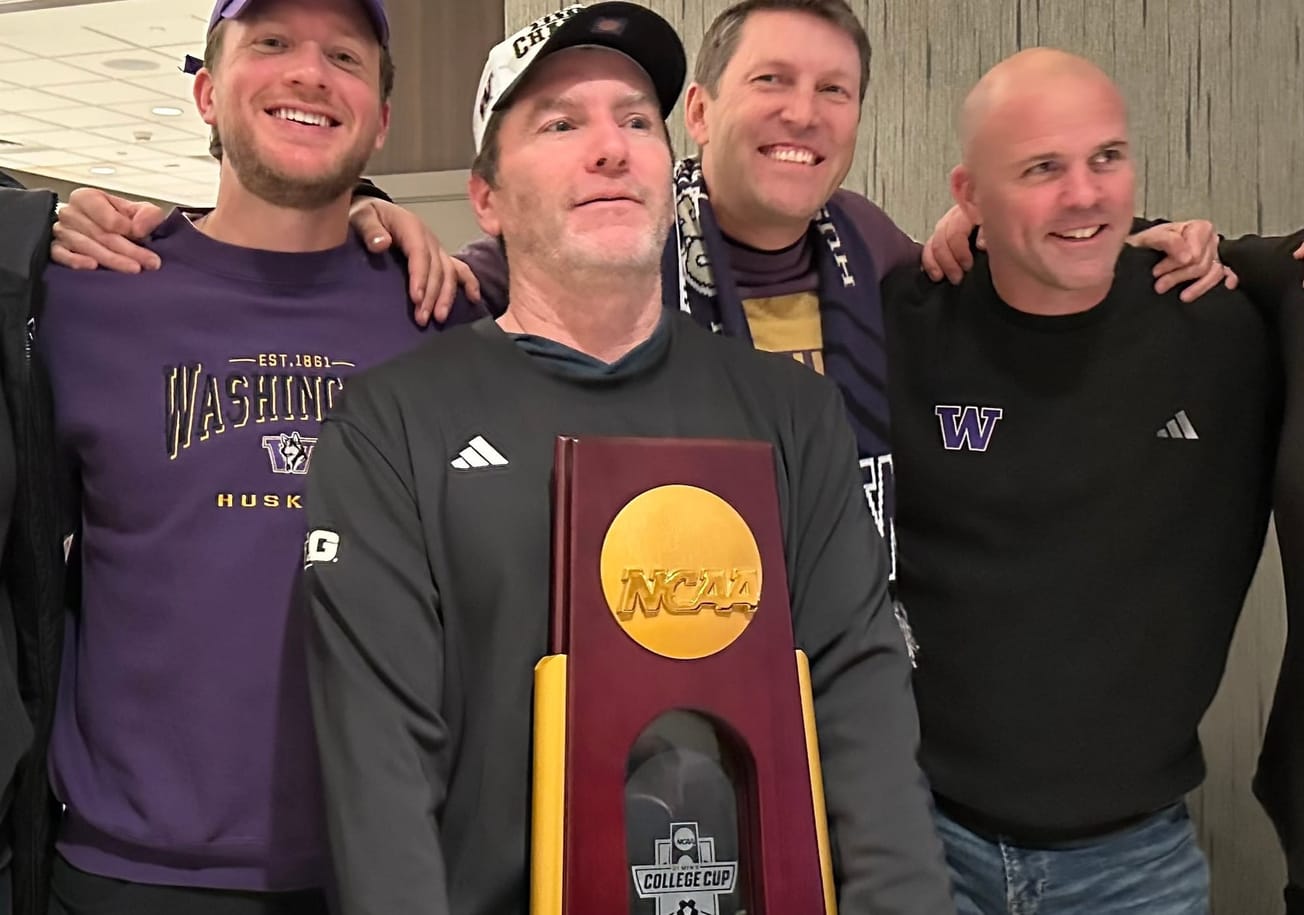
Five days after lifting the championship trophy, Clark found time to email the alumni, beginning with, “I hope every person on this email feels the same sense of pride. For 63 years of UW soccer, we have been building toward this.”
In concluding, Clark savored a byproduct of the journey which began way back in Jepson’s day.
“What I loved most of all though was hearing about you guys reconnecting and uniting along this special run,” wrote Clark. “Whether through text threads or watch parties, guys were connected and fully locked in on this year’s Soccer Dawgs. Sports can be magical and knowing that this team brought joy and community to so many people connected with UW was amazing.”
This story first posted on the author's local soccer history blog, FrankMacDonald.net.