Andrew Thomas was at the lowest point of his professional career when the Seattle Sounders lost their shootout against Minnesota United that ended their 2025 season. Having been trusted by Brian Schmetzer to enter the game just before the end of regulation to be in net for the anticipated spotkicks as Seattle sought a place in the next round of the MLS Playoffs, he had a chance to continue climbing in a season that had already seen him reach new heights as a professional player. Despite dislocating his finger while forcing an attempt wide on the first shot, he went on to make a pair of saves during the shootout. But when it was his turn to shoot in the 10th round, Thomas clanged his spotkick off the crossbar.
As Minnesota celebrated, he could feel the ground drop out from under him.
“You feel that you’ve let your teammates down, you feel like you’ve let the fans down, the city down. That inevitably just takes a period of time to accept,” Thomas recently told Sounder at Heart.

This article originally appeared in IV: The Sounder at Heart magazine. Issue 1 serves as a preview of the 2026 soccer season with a profile on Andrew Thomas, a statistical deep dive on the Sounders 2025 season, a feature about Cristian Roldan, a Q&A with Brian Schmetzer, a look at how women’s soccer has become big business and a column by G. Willow Wilson. Issues are still available in print ($15) and digital download ($5).
After letting himself sit with that feeling for a little while, he got to work reviewing film to see what he did wrong, or at least what he could have done better. Assessing his performance in the shootout and the game that preceded it.
“I was stuck in this, like, ‘why didn’t I just strike it a little bit more? Why didn’t I save the previous one, why were my hands a little bit stacked on the penalty?’ I have that 99 times out of 100,” he explained, glossing over the impact of having his finger jammed back into place, which remains somewhat swollen two months later. “Okay, well, what’s next? I prepared the way I wanted to prepare. I was as confident as I’ve ever been in that shootout. I felt great going into the game. Sometimes, it just doesn’t go the way that you want it to go.”
Thomas had waited a long time for that opportunity, building his experience with the Sounders’ second team, going on loan and then getting opportunities in secondary competitions. It didn’t quite have the dramatic crescendo he wanted, but it’s now looking well worth the wait.
“I don't think that I would say patience is necessarily my strong suit,” he explained. “I've been forced to be patient at times with back injuries and whatever else, but the urgency and the drive to get to each next subsequent stage has been relentless and motivating, but then also frustrating and everything that comes with having to kind of slow down the progression that you may have been chasing.”

Entering his sixth professional season, Thomas' time seems to have arrived. Schmetzer has not yet named Thomas the starter, but all indications are that it’s his job to lose. Assuming he claims the spot, he’ll follow in a tradition that has seen some of the best goalkeepers in MLS and American soccer history lead the Sounders defense, with one of them standing in the shadows ready to reclaim his spot. His journey has featured plenty of dead-ends and splits in the road.
Long before moving to the U.S. or turning pro he worked his way up through the Watford academy with his younger brother Alexei, who also happens to be a goalkeeper. Then with offers to turn professional in England, he opted to move across the ocean and go to Stanford where he would play soccer and pursue an engineering physics degree.
At Stanford he redshirted his freshman year, not taking the field as the Cardinal became NCAA Champions, before going on to rack up both academic and athletic honors while helping his team win two Pac-12 Championships in the next three seasons and making decent runs at the NCAA tournament, including a semifinal run in 2019.
Next came the Sounders where he joined a crowded goalkeeper group in 2021, full of experienced players ahead of him and headed up by club legend Stefan Frei. Time and time again he waited for his opportunity, because that was the best path to success.
“Obviously, Stef has every accolade under the sun… but at the time, you know, Stef Cleveland had been playing and playing very well, proving that he was able to be a starter in the league. Spencer Richey had played 30 games as a starter in Cincinnati at that point,” Thomas said, describing the group he joined midway through the 2021 season. “So it’s this selection of fantastic goalkeepers, and I think the thing that I came in with, primarily, was just to take in as much information from all of these guys as possible.
“Day 1 with Tommy [Dutra], it was five things I needed to work on. And you get your five things and then you’re still watching Stef [Frei], and you’re getting everything from him, and his leadership as a teammate is such that he will be as much of a coach to me as Tommy is.”
It wasn’t just Dutra and Frei that he was learning from, though.
“Cleveland was there too, and he does the same thing and you kind of get the entire wealth of experience where everyone has something that they can contribute in that situation. The stuff that I learned in Stef Cleveland was how to manage being backup and play behind Stef [Frei], and competing every day, showing up with the right attitude, and making sure that the training environment is positive as a whole. Because it’s very easy for goalkeepers especially to drag down the energy completely,” Thomas explained. “It can be very hard to be the one that’s driving the entirety of the group upwards, but it’s very easy to be pulling the entire group down. … It’s just a continuous process of implementing little things that I picked up from all of these different people.”
It’s that attitude and approach that have allowed him to reach this point in his career, now competing with Frei to be the Sounders starting goalkeeper. Some of it is second nature to Thomas, who is thoughtful and analytical to an extreme.
“I would say that I’m analytical almost to a fault,” he explained. “I like problem solving. I like being given a problem to work out. … I don’t think I have a particularly entrepreneurial mind or something like that where it’s, you know, complete freedom to do all these other things I want. No, this is your goal. Figure out a solution.”
For a position where the skills and techniques can be analyzed in video sessions, then honed through repetition and precise training, and the whole game is laid out in front of them on the field, that analytical mind is certainly a benefit.
“The easiest example is taking something in math,” as Thomas put it. “Where it was a struggle to figure out how to solve this equation, whatever it is, and then all of a sudden it clicks, and from that point on it’s kind of become second nature. And you could definitely apply the same to cricket and soccer.”
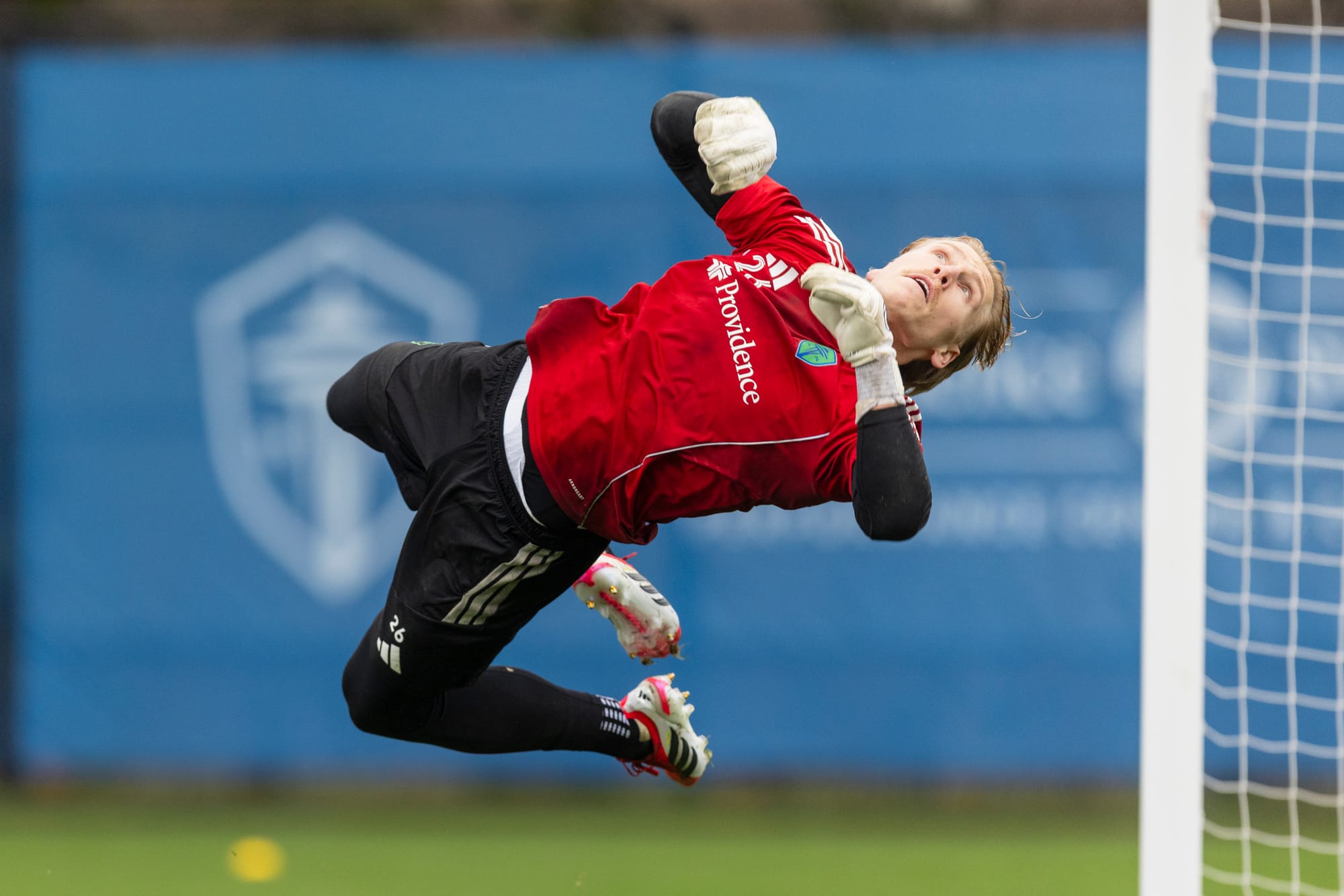
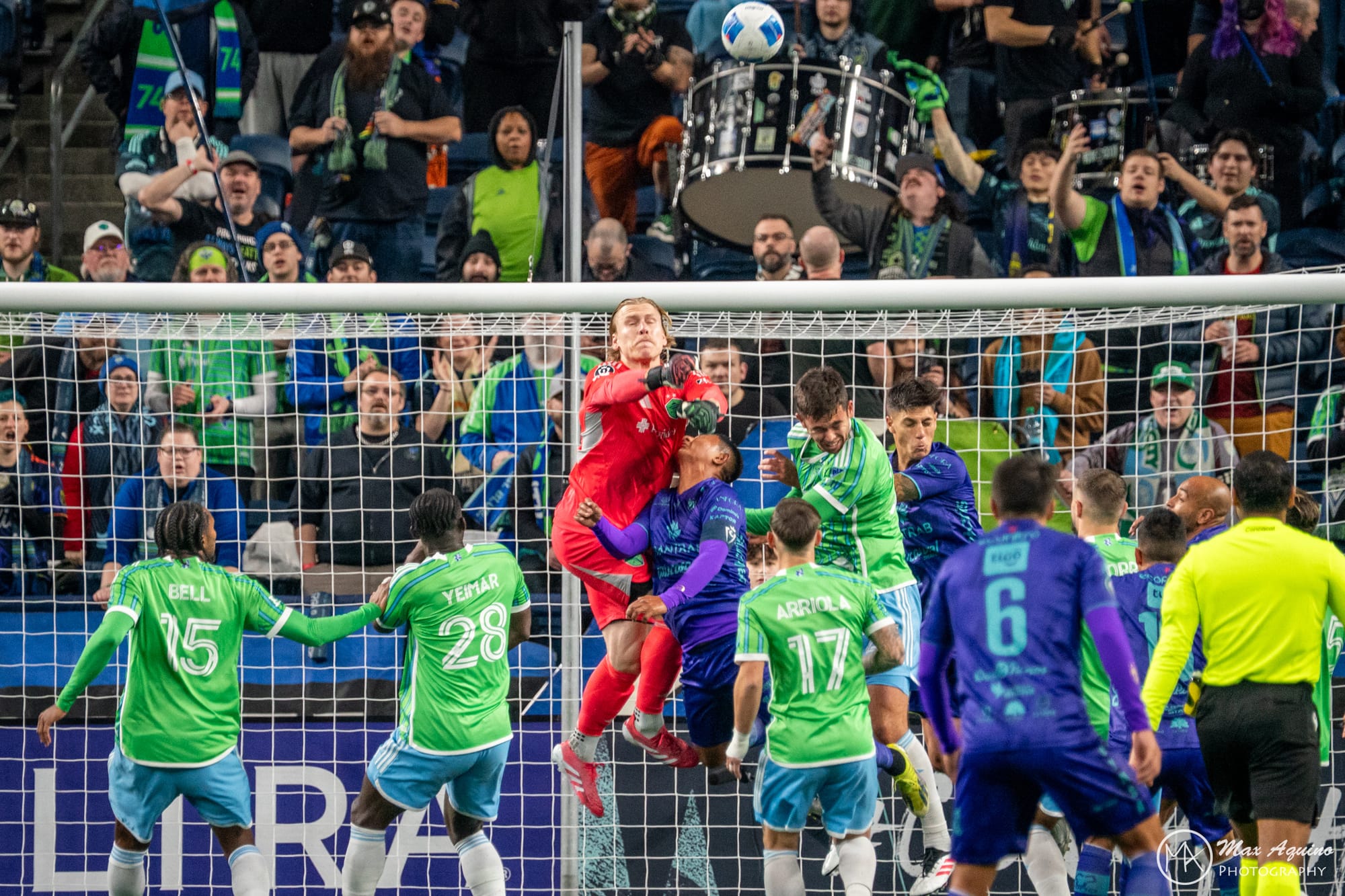
Photos by Noah Riffe and Max Aquino
Natural gifts or inclinations are seldom enough to get a player to this level, though. While some of what’s gotten him to this point is in his nature, his upbringing has played a similarly important role. Born in Moscow to a Russian mother, Svetlana, and an American father, Matthew, Thomas and his brother were given constant encouragement and reminders to focus on the effort they put into whatever they were doing rather than the accomplishments that might come along the way.
“It was just always about effort. It was never about the outcome,” said Thomas. “It was always about how much you committed to whatever it was you would do, and that mentality, which I know for a fact they both apply to their lives, is the underlying bedrock of building whatever technical and tactical and whatever pieces you layer on to get the results. But the effort was the only thing that they ever really spoke about, and when the effort is there, more often the desire to learn is there in the enjoyment that comes from that.”
Knowing that he had done everything possible to prepare for the Minnesota shootout certainly helped put the loss behind him, but Thomas also had some previous experiences that he could lean on. That night in St. Paul was hardly the first time in Andrew’s sporting life that he’d known real disappointment.
He had to navigate a back injury not long after arriving in Seattle and redshirted during his freshman year at Stanford, but before all that his greatest disappointment had come as a cricketer. As an under-16 he was called up for an England u-17 trip to Dubai where they would play against Pakistan’s u-17s in four competitive games. It was his first call-up to any national team and he was one of only three u-16 players called into the camp, and as a wicket-keeper (a fielding position in cricket that’s somewhere between a goalkeeper and a catcher in baseball) he was only involved in one of the games on the trip.
“That was the first time where I’d been in a very uncomfortable situation,” Thomas explained. “I was abroad, I was on this tour with guys I didn’t know, and then I wasn’t even playing or really able to contribute in any way… so there was this love of the experience, because I felt like it was really cool to be here and I had an England badge on my jersey, but then didn’t have all the outcomes that I had wanted. So it definitely furthered my excitement for sport but then showed me that there was always going to be times where you’re in an uncomfortable situation, you’ve got to find a way to get through it and past it. I came back from that cricket tour having had fun, but also disappointed not to have played much.”