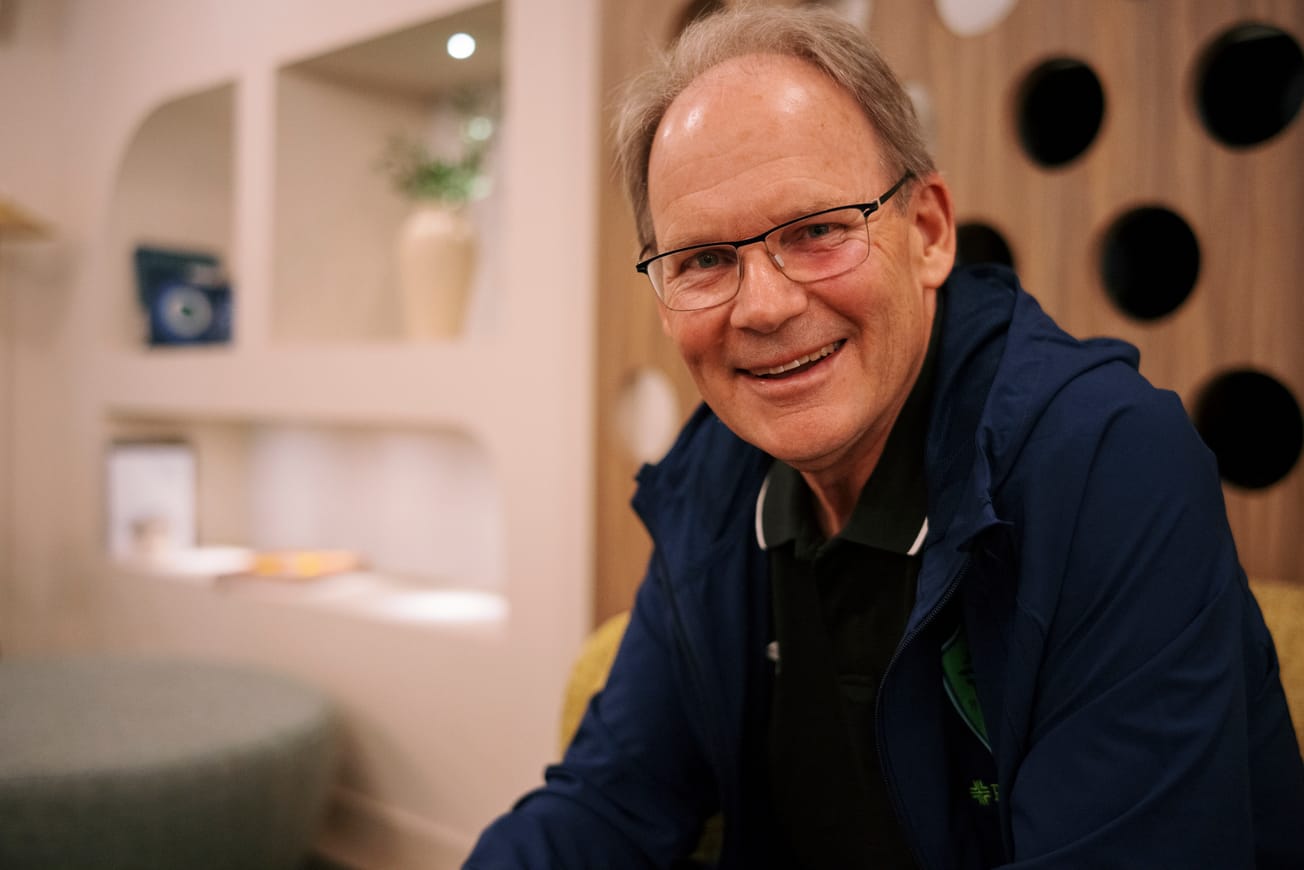
MARBELLA, Spain – Brian Schmetzer looked fraught when we sat down with him at the team hotel in Marbella, Spain. The Seattle Sounders love doing preseason here in part because the weather is usually predictable. Even if it’s not perfect, it’s at least playable. As luck would have it, the conditions were so bad that the Marbella Football Center wouldn’t allow players onto their pitches.
Even more concerning was the reality that the weather wasn’t looking likely to break anytime soon, leaving the Sounders scrambling to find a potential alternate venue for their final preseason matches abroad.
Once the mic turned on, Schmetzer’s mood changed almost instantly. His warm smile broke into stories, anecdotes and insight from more than two decades of coaching the Sounders giving us some insight into how he’s managed to stay on top of his game for so long.

This article originally appeared in IV: The Sounder at Heart magazine and was edited. You can listen to the full audio here or watch the video below.
Issue 1 serves as a preview of the 2026 soccer season with a profile on Andrew Thomas, a statistical deep dive on the Sounders 2025 season, a feature about Cristian Roldan, a Q&A with Brian Schmetzer, a look at how women’s soccer has become big business and a column by G. Willow Wilson. Issues are still available in print ($15) and digital download ($5).
QUESTION: You’re going into your 10th full season in this job. You’re the longest tenured coach in the league and the second longest ever. To what do you attribute that longevity?
ANSWER: We have a stable club and a stable boss. I'm appreciative of Adrian keeping me around, even back to the USL days. I would say that I've had really good players. A lot of times in life, it's right place, right time and I was a beneficiary of that coming in.
It wasn't just Nico Lodeiro, obviously, who was a big part of it in 2016. He came and changed some things. It was a spark. We all know that story. But if you look at who I had in that locker wroom – there was a good frickin team. That was a seriously good team, I just kind of rearranged the pieces and had a different message. It worked.
The final part is the coaching aspect, I'm not a systems-based coach. I think that's where maybe I was able to kind of flex a little bit here, change a little bit there. Peter Vermes certainly had a lot of success being a systems-based coach and there's other coaches that have success – but our league is too fluid. There's too many rules.
In my environment, I think change has been necessary. I think change has done me some good.
QUESTION: The team has also been remarkably stable. I think that’s sometimes taken for granted. What’s allowed this team to be so cohesive?
ANSWER: When we started in 2009, Sigi [Schmid] put out some strong messages about the team and how he felt it was important to be a group. You’re always more successful with a bunch of players that work together and fight together rather than 11 individuals. That's common sense.
My spin on things is partly due to some of my own personal experience as a player. I told these guys the other night at the beginning of the year and if I had a contract, I made a commitment to that group of players for the entire year.
There were years where I wasn't happy. If wasn't playing enough or the coach didn't like me or I thought something was unfair, my commitment to my teammates never wavered. I waited until the end of the season to go into the front office and say, ‘This didn't go well, and I'd like to change this,’ and that's my belief.
When these guys sign a contract for the Seattle Sounders, they have to make the same commitment.
Then you couple that with character. When we hire people we would rather pick a person that we feel has really top character over [someone] that might be a little bit more qualified or have some more experiences. That's paid off handsomely for us.
QUESTION: Two players who could have potentially left this offseason were Paul Rothrock and Stefan Frei. You had both of them at a Washington Legends of Soccer event toward the end of season. A. Did you ever worry that could backfire? B. Do you think anything that happened at the event influenced their decisions?
ANSWER: I was more worried about Paul. Paul had a tremendous year, he left a lot of money on the table to stay with this club.
I was really concerned that he was going to be gone. I'm tickled that he would put values in what he wants to accomplish with this club and some of his experiences that he's had. He wants to continue those.
I couldn't be more impressed with his commitment to this team, the fans, everybody. When you find a player like those guys, you have to keep them.
QUESTION: Prior to taking over for Sigi Schmid in 2016, you had interviewed for at least a couple of other jobs. How do you think you would have tried to translate the success here somewhere that didn’t have the same sort of built-in culture?
ANSWER: Hate to lose. Never quit. Fight for your teammates. Build culture.
I felt I could have replicated some of the things that made me successful up here. You have to trust who hires you.
I've been around a lot of leadership conferences. There’s lots of things that you can read about building culture. A lot of that stuff is common sense stuff. But it's the how and it's the whys.
The timing is almost more important than the words that you use.
If a guy is pissed, you can't talk to him about it, you just have to let him blow off some steam, let him swear at you, get pissed and come back the next day and you say, ‘well, now let's talk tactics.’
I think my job is more about managing people. Freddy Juarez, Gonzalo Pineda, those guys did a lion's share of the coaching and my ability to manage people I'm very confident in. I know I can manage people. I know I can get the best out of people.
QUESTION: I think you coined the phrase that the ‘club is the relationship between the fans and the team.’ Dig into that. How do you consistently feed that?
ANSWER: When some of the players don't do the lap [to thank fans] after a loss and they go right to the [locker room] – I have done this a few times; not many, but a few of them march into that locker room – I wait till everybody gets back in and I say, ‘You motherfucker, you fucking don't. That will never happen again. You will walk around and clap. Those people pay your salary.’
I'll say it just like that and they know I'm serious. I don't use that very often. But in the right moment I will, because it is important for us to acknowledge the fans that are in the building, especially the away fans.
QUESTION: We are on the precipice of MLS entering a new era, one that seems to inevitably be driven by money and spending in ways it hasn’t before. Is there something the Sounders will need to do better to maintain their place as a model franchise?
ANSWER: We have to get our DPs right. When we spend the money, they have to be good. I think we did so far.
We have to maintain the culture, the character, the never quit. We have to continue to try and evolve tactically. You have to find diamonds in the rough. You got to play good defense. Got to have a great goalkeeper. We have to be very good about the players that we select.
That’s been one of our strengths as a coaching staff is we can maximize players' potentials by giving them opportunities.
QUESTION: You are seemingly in a very nice place right now. Whenever you decide to step away, how do you want to be remembered?
ANSWER: That I left the club in a better spot than when I got here. I don’t want to compare myself to Sigi Schmid, who got us off to a great start.
It’s been long. It's been hard. There's been challenging moments. There's still going to be challenging moments. We’re doing the best we can to treat people well. We have always wanted to under-promise and over-deliver.