Last week, MLS released its 2026 General Allocation Money (GAM) figures and Roster Profiles at the conclusion of the 2026 Secondary Transfer Window. Those figures help drive decisions not only for now but for the future as well. As many of you know, GAM can now be carried over year-to-year, and roster situations are more fluid than ever as front offices continue to figure out ways to work the MLS rulebook.
The Sounders are a proud club that has struggled in league play over the last couple of seasons. Sure, they’ve won Leagues Cup and participated in the 2026 Club World Cup, but many fans are frustrated by what they see as the club’s shortcomings. Much of the commentary I’ve seen online is about the lack of spending on transfer targets and how the club has kept its powder dry. They recently bought Dejan Joveljić for $6M from Sporting KC and added Caden Clark as a U22 initiative player in the latest window. The Joveljić move was massive, as it gave the Sounders a big striker, something they’d been missing as of late.
How does this fare going forward? Do the two moves actually hurt the Sounders for the future? Well, let’s dive into the GAM situation and then the roster itself.
GAM
The GAM situation for the Sounders is actually very interesting. Seattle is currently carrying the 9th-most 2026 GAM as of the league release. A lot of that GAM is coming from the Georgi Minoungou deal; Minoungou was traded to the Colorado Rapids for $2M in GAM, half coming in 2026 and half coming in ’27. Along with that, the Sounders have traded six of their international slots, helping them stockpile allocation money.
However, the bigger aspect is the 2027 GAM. Once again, 2026 GAM can be rolled over into 2027 and more than likely, all of that remaining $1.9M will be pushed to 2027 roster building. We’re still not sure how the Sprint or 2027/28 seasons will work, rule-wise, but under the assumption that GAM still exists (which I’d bet it will), it’ll still be a valuable team-building piece.
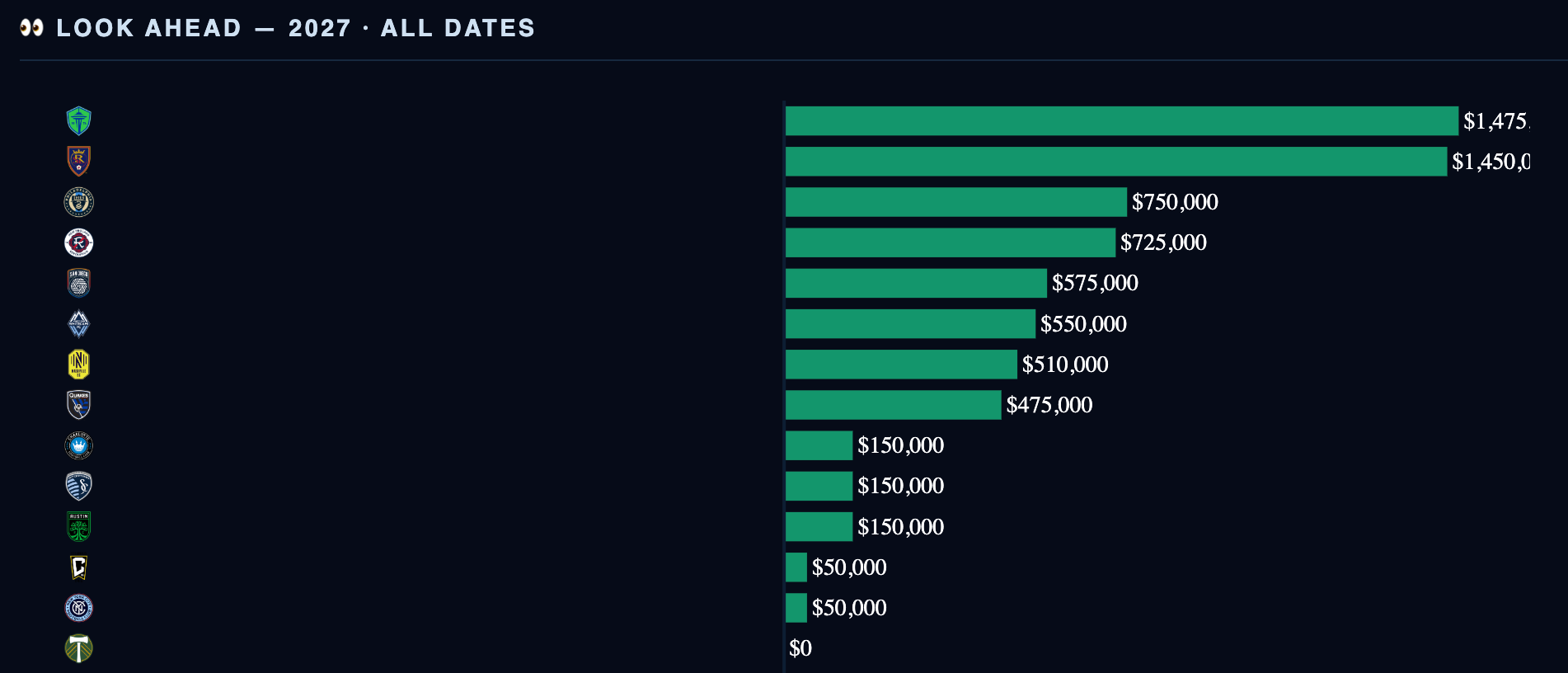
The Sounders, per the app I run (GAM Is Fun) have run up a $1.475M surplus in 2027 GAM alone. Along with the Minoungou trade, some of the international slots sold this season have netted them 2027 money. If you pair just those two sources together, the Sounders could have the sixth-most allocation money to start off the sprint season. That’s not including the Obed Vargas money, which could add another $1.5M in GAM to the books (whenever the payment is due); or potential proceeds from the Danny Leyva and Reed Baker-Whiting moves. That would give the Sounders a potential $8.8M in starting GAM for the 2027 Sprint.
The Sounders have options for how they could use that GAM stockpile. The team could stay put, preserve that allocation, and roll it over into the 2027/28 season, starting to spend it in the summer. The team could use it to buy down a bunch of deals before that season, utilizing the Sprint campaign to build a roster before the main season begins. Again, it depends on what the club wants to do with its space. They will have more space than a lot of other teams, and with their savvy usage of international slots, I bet there’s even more money to make. Overall, the Sounders, GAM-wise, are in a healthy spot and should have plenty to spend if they choose.
Roster
Now, here comes the real question: do the Sounders have space on their roster to make improvements? Well… they do.
On my newsletter, Footy Analytic Musings, I talked about how the Sounders are partaking in one of the trends that’s been popping up a lot in MLS: renegotiations. If teams negotiate a new deal for a player, they can actually change classifications. The Sounders did this with former Designated Player Albert Rusnák in order to open up a DP slot for Dejan Joveljić to join. Basically, if the average of the player’s new budget charge and old budget charge is below the max TAM line (the maximum budget charge + $1M), a player can be reclassified. In the case of Rusnák, his old deal expired in 2026 with an option in 2027. Rusnák signed a two-year extension that bumped his average salary below the TAM line, exchanging a higher salary for increased security via guaranteed years and likely more overall money.
The Sounders actually have two more DPs who, as of next year, could be eligible for the same thing: Jordan Morris and Pedro de la Vega. Morris’ deal ends in ‘27, while PDLV’s ends in ‘27 with an option in ‘28. Those would both be eligible for a similar renegotiation. Do you extend Morris on a smaller deal to open up that DP spot? The Sounders have another option for PDLV if they do not want to extend him.
De la Vega is a full Designated Player. He cannot be bought down… yet. The Sounders could choose to do what the New England Revolution did to open up a DP spot and trade him for a very cheap cashfer deal. De la Vega is on a $1.3M salary, and whatever team acquires him can potentially only have their cashfer fee hit the budget charge. In the case of Tomas Chancalay, the Revs exchanged him for $100k to Minnesota United. This allowed Minnesota to make him a TAM player, because the transfer fee was small enough when combined with his salary that he was now eligible to be bought down.
Could a team buy low on de la Vega, see how he does for a year, and then evaluate if he’s worth it? It could be a win-win, allowing the Sounders to move on and clear a DP spot (if they choose) and another team can take a chance on a player and evaluate if they want to keep him going into the 2027/28 season. This is the only way the DP tag leaves both teams; any other trade would require one team to hold the tag.
For U22 roster spots, Nikola Petković is a loan and Caden Clark has a contract that expires at the end of 2026, with an option for 2027. If the Sounders want to open those spots, they could decline the purchase option for Petoković and decline the contract option for Clark. In the case of Clark, one of DC or Seattle had to keep the tag this year, but he would not be a U22 in a new deal.
They then could have up to five discretionary spots to work with. Many teams have players on longer-term deals and would need to be creative to open up those spots, but not the Sounders – there’s a clear way to open every DP and U22 spot beyond Joveljic’s. At the very least, they can let every current contract expire and have them all open in the winter of 2027.
Overall
The Sounders appear to be in a healthy spot when it comes to their salary cap and roster flexibility. Craig Waibel won’t really have outside restrictions when it comes to roster rules; there are a lot of tools in the toolbox that the team can use in order rebuild the roster. This analysis doesn’t even touch on other expiring deals such as Yeimar, whose TAM deal could open up even more money to spend.
The part that matters, though, is what the team will do with their available resources. Like I’ve said, they seem to have done a great job managing the cap and have no excuses or roadblocks, at least rules-wise, to building a new roster.
Arman Kafai runs Footy Analytics Musings, a site designed to help people understand various soccer metrics. Previously, he worked as FC Dallas’ data consultant.