With the closing of the regular season just a week ago, likely so too did Jordan Morris’ 2026 season, as the Seattle Sounders learned he suffered a quad injury forcing him out for the next 4-8 weeks.
Unfortunately, this was just another long-term injury in a maligned year. To give some perspective on just how rough this crisis became, Sounder at Heart's Adam Race came up with a new statistic – Top End Roster Stability, or TERS – to quantitatively track it.
Recently, I took it upon myself to develop TERS into a stat family to encompass intangibles like player quality, whether a team is over- or underperforming, or if they should have been performing the way they were.
I’d highly suggest giving both articles a read if you haven’t already. Either way, here’s one question that each statistic answers. Take it as a recap or refresher:
TERS+: How stable is a team’s “core” over a period of time (we’ll just be looking at full seasons)?
TER$+: What’s the quality of a team’s “core”?
TERP$+: Is a team under or overperforming their true level based on their quality and health of its “core?”
TERP$+ Differential: Should a team have expected to perform the way they did?
We’ll start with analyzing the league as a whole, then look at how the Sounders compare to others’ health, quality, and performance. Let's get into it.
Western Conference
These charts get a little bit unwieldy when showing so many teams, but I think they’re useful to be able to look at. In order to create digestible bites, I broke each graphic into conferences, and I’ll analyze via some simple superlatives and color-commentate some context.
When you’re done looking at the pretty colors, scroll on down and we’ll discuss who the leaders are under each statistic.
TERS+
Most Improved: Well, I almost picked someone else given their current season, but I’ll name LAFC. While 2026 was… inconsistent by their own standards, the previous five years showed significant improvement in health and stability. 2021 was a low point, as several key players were injured and the club missed the playoffs for the first time.
Every year since, the team became more and more stable, though some would argue that ended up being their demise this year as a lack of rotation and sale of a key contributor in David Martinez caused them troubles as they got worn down.
Most Consistent: FC Dallas. After a 2021 that was horrendous on the defensive end, didn’t have epic goalkeeping performances like Jimmy Maurer's 2020 season, and used a formation that didn’t suit their personnel until halfway through the year, FC Dallas generally rebounded. From 2023 on, they were essentially bang on league average or nearabouts in terms of roster stability. Steady Eddies.
Most Concerning: Real Salt Lake and Sporting Kansas City. Truthfully, I couldn’t really pick between the two. Each of them start off the post-COVID-season era quite well as the two sides with the most stable XIs, then… insert falling-cartoon-whistle noise.
These two teams got to this place in very different ways, and have pretty linearly decreased in lineup stability every year up until now. SKC finally were burnt out on Vermes Ball and lacked the sporting infrastructure to keep up in a modern league, while RSL trundled along without much in the way of squad depth, and consistently sold away their difference makers without replacing them at a high level, leaving Pablo Mastroeni to send hopes and prayers to their athletic trainers so the remaining players could stay on the field.
KC have some hope — they’re at the start of a brand-new era and just might be able to find stability with a refreshed core under the guidance of an entering-year-two David Lee and an undecided new head coach (bye, Raphael Wicky!). Real Salt Lake, however... Hard to say what next year brings.
TER$+
Most Improved: Hey, Colorado Rapids! Things have gotten much, much better under head coaches Chris Armas and Matt Wells. In 2021–2023, Colorado were well, well below the league average on team stability relative to roster quality, and it mostly showed in the results — aside from a 2021 season that was mostly based on extremely high-quality defense that conceded just 35 goals — second best in the West.
In 2024 and beyond, clear identities under two head coaches and an infusion of high-level talent from the draft, outside the league, and undervalued assets like Djordje Mihailovic, Moise Bombito, and Josh Atencio managed to boost Colorado's player quality and keep them above average in stability weighted by player quality despite trending less healthy in that same timespan.
Most Consistent: Yep, it’s Dallas again. Though their spending hasn’t changed too much, they generally replaced high quality players — like Pepi, Ferreira and Tafari — with guys of equal system importance in Musa, Farrington, and Urhoghide. Replacing is good, but it only does so much if it’s simply in line with the spending across the rest of the league, which is why they never bounced higher up in this stat despite — in some cases — higher quality players.
Most Concerning: San Jose Earthquakes and Austin FC. Luckily, I don’t think either really have much to worry about — one of the reasons these stats still need context.
San Jose were more than overperforming the league average weighted by player quality at the start of the decade, and since then have precipitously fallen toward the bottom. Part of this has more to do with the fact that San Jose didn’t pay very much in player wages, meaning that the dropoff from one player to the next wasn’t as large as, for example, another team losing a Giakoumakis and plugging in a Jamal Thiare.
This year, they had some injuries to key guys in Niko Tsakiris and Timo Werner, but under the leadership of Bruce Arena, should be able to continue building depth and have better health luck next year.
Austin FC, on the other hand, have had some questionable roster building decisions in the last few years — and occasionally ponderous if not bland tactics — but look likely to be in better shape next year with Jim Curtin and Khaled El-Ahmad at the helm.
TERP$+
Consistently Overperforming: Real Salt Lake. Since Pablo Mastroeni's first full season at the helm of the Utah-based club, RSL have finished 2nd, 4th, 3rd, 9th, and 2nd in TERP$+, or sporting performance relative to roster stability and quality.
Part of that is mentality – Pablo Mastroeni's teams "have that dog in [them]", generally playing to more than the sum of their parts, which has allowed them to withstand injuries to key guys like Justen Glad, Emeka Eneli and Diego Luna, but also make the playoffs in each of the last six seasons - a feat only bested by Orlando City (7).
Another part of it comes down to a robust academy (that was, admittedly, even more productive in the 2010s) and a willingness to scout the MLS Superdraft and rely on talent from it. Some clubs choose to ignore the former or the latter, and most don't do both.
Consistently Underperforming: Sporting Kansas City and Colorado Rapids. Kansas City — as discussed — are in the middle of a rebuild from a multi-decade-spanning regime.
Colorado, on the other hand, have recently spent more money on reclamation project players. Unfortunately, it is the nature of a reclamation project that you might sink plenty of money in without receiving equal benefits more often than not: hence their underperformance relative to theoretical quality.
TERP$+ Differential
Shoulda Done Better: LA Galaxy. Yep, this one should not be surprising at all. While other teams have had lower lowers than the Galaxy in the 2020s, no team has consistently landed themselves in this category year-after-year; essentially never performing better than their talent and availability relative to their sporting performance should've dictated. I think this is something we all knew, but it’s nice to see that the data bears it out, too.
Shoulda Done Worse: Real Salt Lake. I think the last blurb they got holds true here. Mentality is a funny thing in sports. If you can play to a level greater than the sum of your parts, you're going to consistently create your own good luck and break models along the way.
Eastern Conference
For your own information, I've included the other half of the league here. Feel free to draw your own conclusions.
2026 Stats
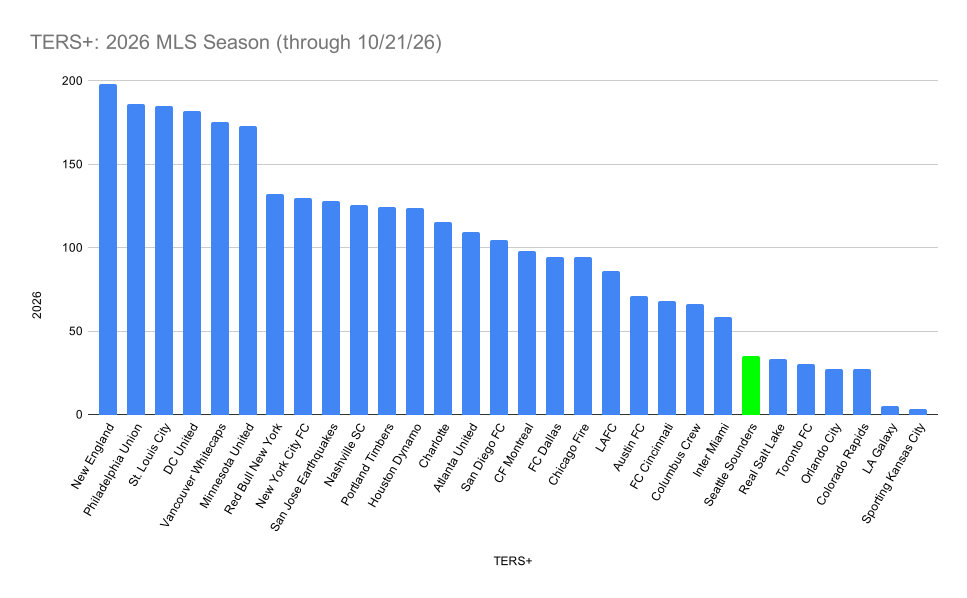
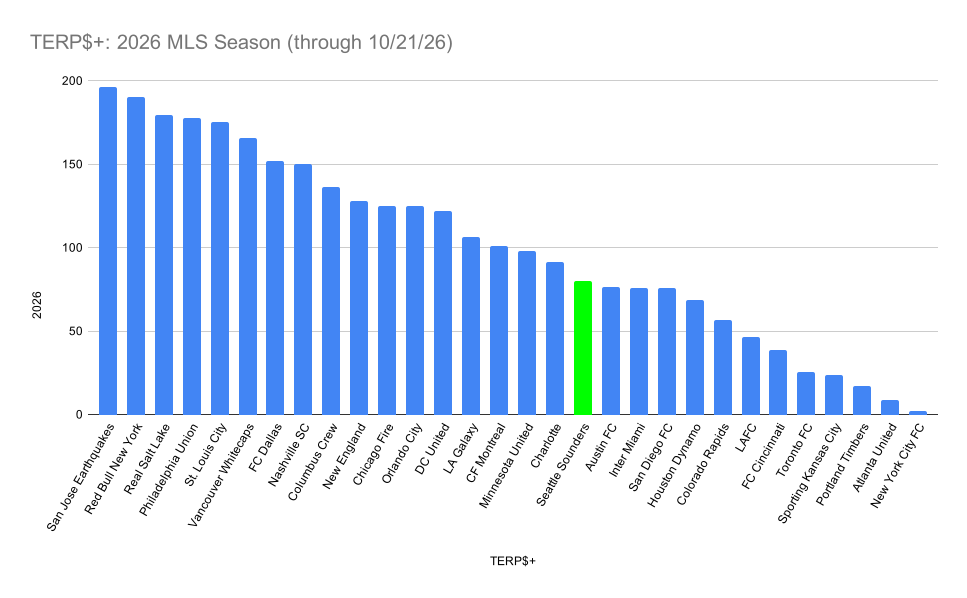
What a tough year. In terms of pure stability of the team's Starting XI, the Seattle Sounders had the 24th most stable lineup in the league, which is to say, not very stable. Looking at the other teams around them, you see playoff teams like Miami and the Crew — missing key players like Micael and Wessam Abou Ali for large chunks of the year, but had enough quality (Miami) or simply had a wild end-of-season run due to coaching changes and an infusion of talent — Columbus won 9 of their last 10 regular season games — to carry them into the postseason.
You also have teams like RSL and Toronto who were much more fringe candidates; experiencing heavy injury crises of their own (Toronto played with all three DPs extremely sparingly, and also missed key players like Walker Zimmerman for almost a third of the season) and selling off key players that sent them into a death spiral (RSL had both problems). Either way, this is not the kind of company you'd want to see the Sounders in.
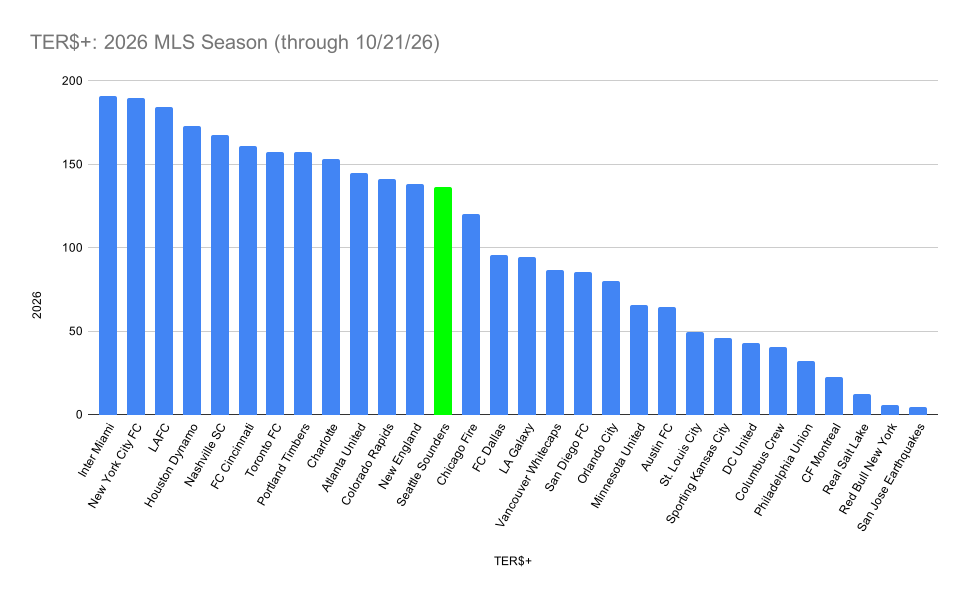
Things get a little bit better when you weigh talent into the equation, with Seattle jumping above the league average on TER$+ into 13th. For all the faults of their high-paid and important players — Morris was rarely fully fit, Pedro de la Vega never played a league minute, Yeimar missed most of the year, etc… — the Sounders still had high-level talent available to them. Albert Rusnák played most of the year, Cristian Roldan was available more often than not despite an injured summer, Nouhou was ever-present (controversially to some) and Jackson Ragen only missed a bit of time.
Those are all high-level players, and when factoring in their availability, it ended up being better than the average team was able to scrounge up.
Factoring in performance, Seattle drops back down the rankings to 18th best on TERP$+, or a little below average. This tells us that based on the quality of their most available players, they underperformed their true level a bit.
At a glance, this is probably right. Starting the year 7–2–3 going into the World Cup break doesn't mesh with going defeated in eight straight and running their winless run to 13 without extraordinary circumstances and a string of bad luck to go with it.
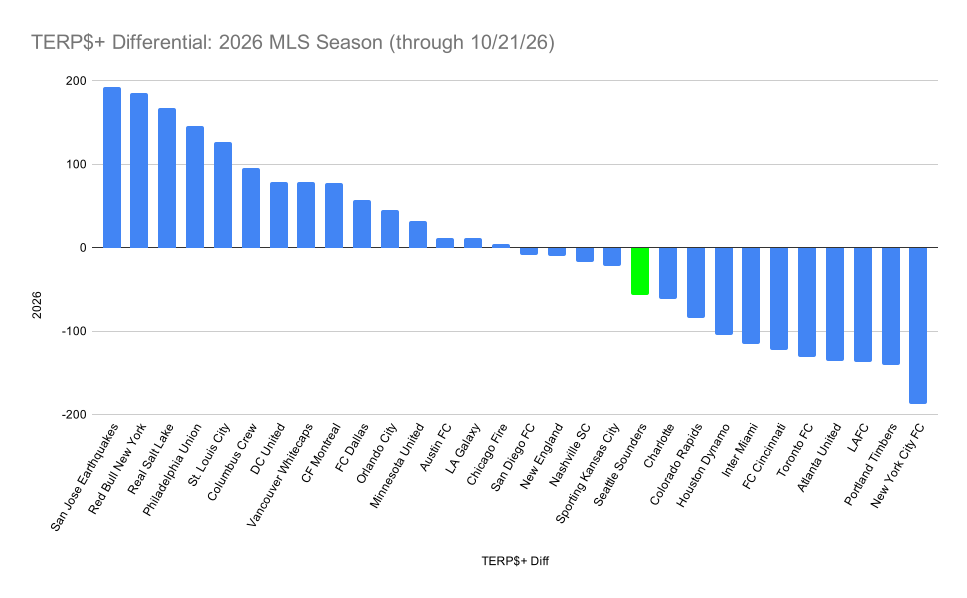
Teams like San Jose clearly overperformed this year — which lines up with preseason expectations being… decidedly lower for them — while NYCFC heavily underperformed.
The latter's a clear as day conclusion, given their midfield was a sieve until James Sands returned from Germany, major regression from Matt Freese especially after the World Cup, and Pascal Jansen refused to change the system after Maxi Morales got injured, expecting Nico Fernandez Mercau to slot in as a creative hub despite him being more of a pure attacking piece.
Even getting star striker Alonso Martinez back wasn’t enough to right the ship for the Pigeons since they weren’t creating the chances necessary to score. It’s not that they didn’t have available quality — they ranked 2nd in TER$+ — it’s that their system failed to utilize the talent they had available.
That underperformance I mentioned on the Sounders' part bears out in TERP$+ Differential: Seattle showing just a tad under average, which means based on their quality and stability, they likely should have been able to earn a few more points than they did. After a winless summer, I'd agree, even if things haven't been perfect this year.
Sounders on Average
Alright, we're nearing the end of the meaty stuff and almost at dessert.
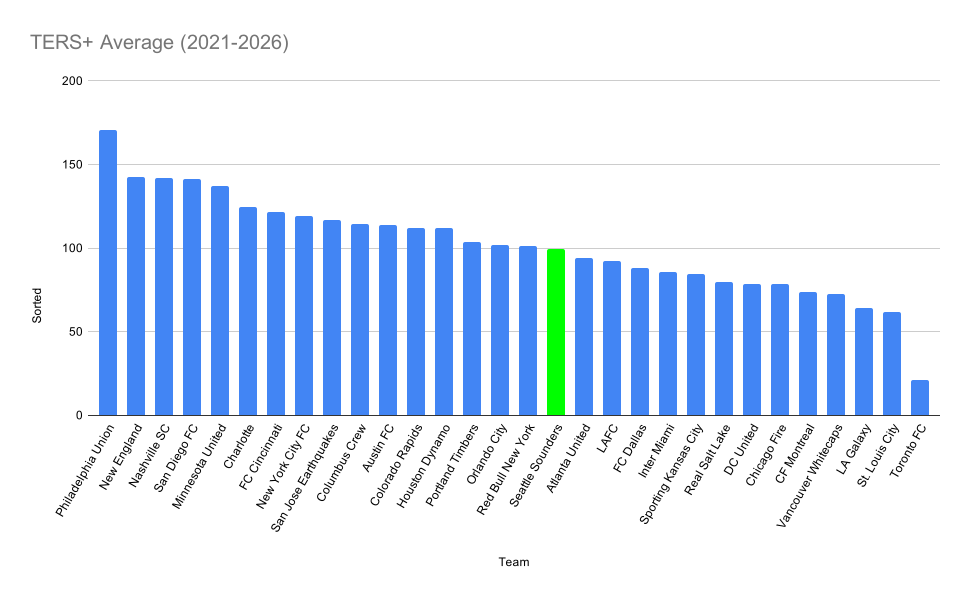
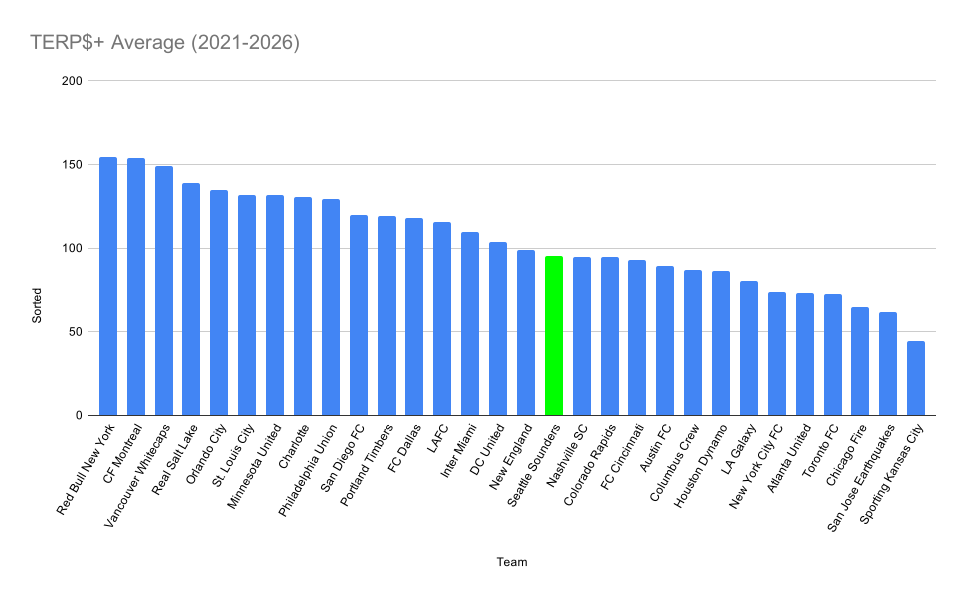
In sports, we often talk about the idea of "luck evening out." As far as injuries and stability goes, it turns out that over the last six seasons, it actually has for the Sounders: they landed themselves exactly at the league average for team stability.
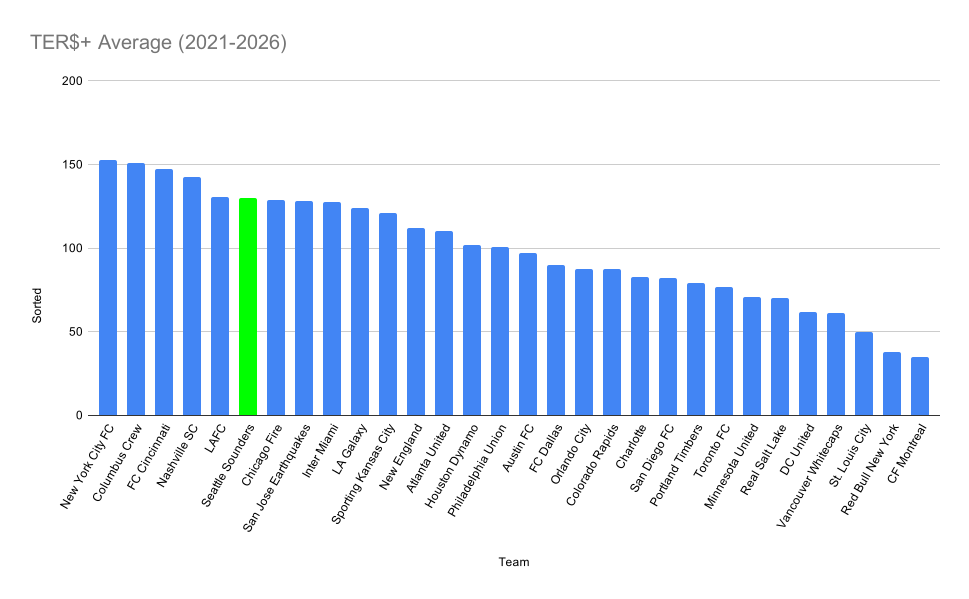
The next thing you might ask yourself may be: "Yeah, but didn't the Sounders lose high-level talent to injury more than other sides?" Shockingly, the answer to that is no. By weighing in talent, Seattle ended up 6th on TER$+, only behind teams like Nashville and Cinci: Hany Mukhtar, Evander, and Lucho, for example, were and are iron men.
TERP$+ tells us that Seattle were very close to average when it came to performance relative to stability and quality — a good thing, but it also meant that they rarely played to more than the sum of their parts like the highest-ranking teams (RBNY, Vancouver, RSL) mostly tended to do.
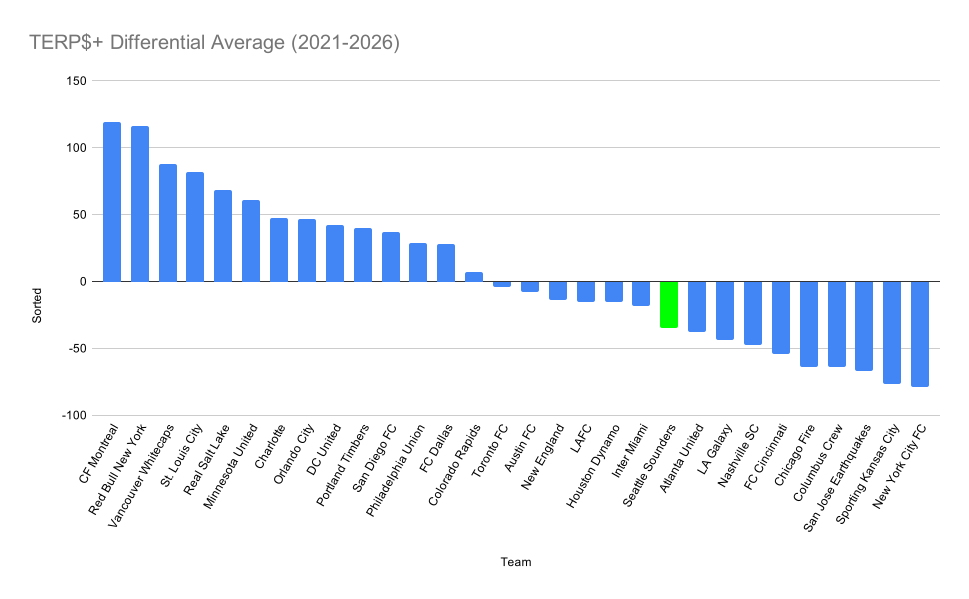
Most concerning is actually where they are on TERP$+ Differential — ranking 21st best and a decent bit below average. This tells us that based on team performance, stability and quality of available players, Seattle should've been performing better over the last several years. Some of that can be chalked up to injuries, some of it to a reluctance to move on from past-prime players in Raúl Ruidíaz and Nico Lodeiro, and some of it down to coaching and other factors. All lessons to learn from going forward.
What do major trophy winners look like?
Supporters Shield
What's the rule?
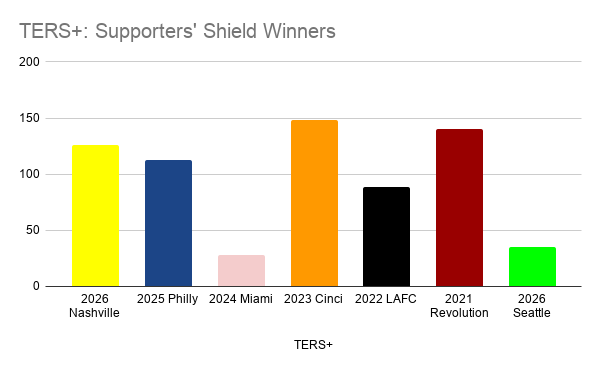
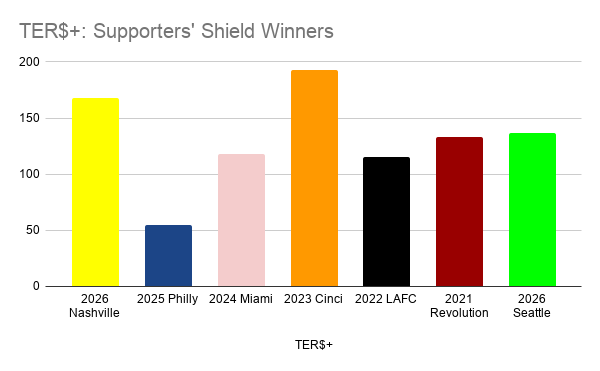
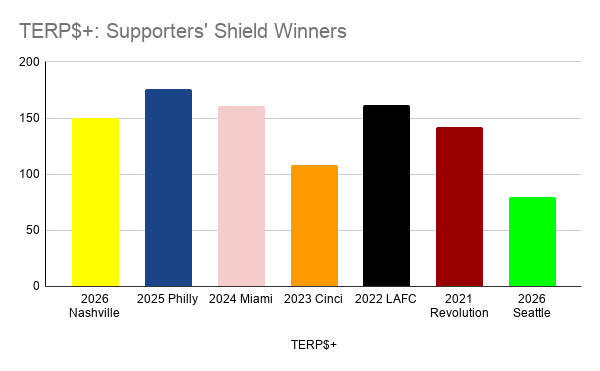
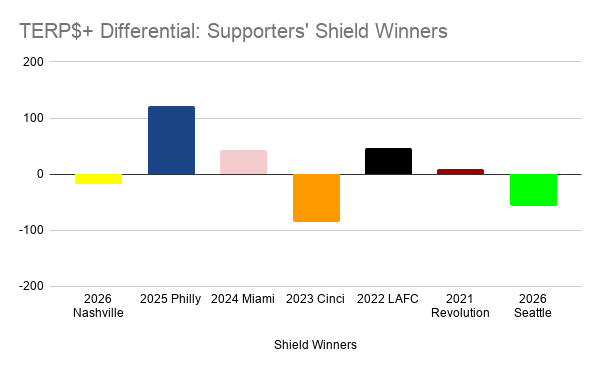
Supporters’ Shield winners tend to be slightly more stable than league average, have their best players available slightly more often, overperform the league average based on quality and availability, and should have performed slightly worse than they did.
All of this makes a ton of sense. If you have a healthier team and your most available players are slightly better than the rest of the league, you’re probably going to have a good chance winning games every week.
Having higher quality players and a higher stability rate also directly leads to overperformance relative to the league average in most cases.
Interestingly, most Supporters’ Shield winners can be expected to very slightly underperform their true potential. This does also make sense, however, when considering that the best and most healthiest teams should, in a vacuum, very rarely expect to lose a game — though parity in MLS brings teams down to earth with a few losses here and there.
You can also phrase the same slight underperformance as "most trophy-winning teams need a bit of luck in a parity-based league, unless you have overwhelming talent across your defense, your offense, or your whole team."
What's the exception?
TERS+: 2024 Inter Miami. Though Miami won the shield that year, even though their most used players weren't always available, they had such high-quality depth that their level never dropped much when players were injured or simply rotated. Having a lot of depth affords flexibility.
TER$+: 2025 Philly and 2023 Cinci. The Union managed to be an outlier on the low end simply by playing moneyball to the maximum. We all remember Bradley Carnell's single full season in Philadelphia — no one expected them to play as well as they did, but their youth were truly exceptional allowing them to beat the odds.
Cinci were the outlier on the high end by having their best players available almost all the time. The difference: They paid a lot for defense. Miazga, Nwobodo, and Barreal were 3 of their four most used players. As the axiom goes "defense wins championships", and by having an extremely stable spine, they had an abnormally strong TER$+ score.
TERP$+: No real exceptions here. All teams picked up more points based on their stability and quality relative to the league average - this should be expected of any team winning the award for most consistently winning.
TERP$+ Differential: 2025 Philly and 2023 Cinci, again. It was entirely reasonable to expect a Union side under a coach in Year 1, with so much turnover, and paying their players so little (relative to the rest of the league) that they should've performed worse. It's also reasonable to say that 2023 Cinci should have performed better - relying on defense is great and will win games, but their very common 1-0 leads also meant that they gave up points that teams with a better offense wouldn't have.
MLS Cup
What's the rule?
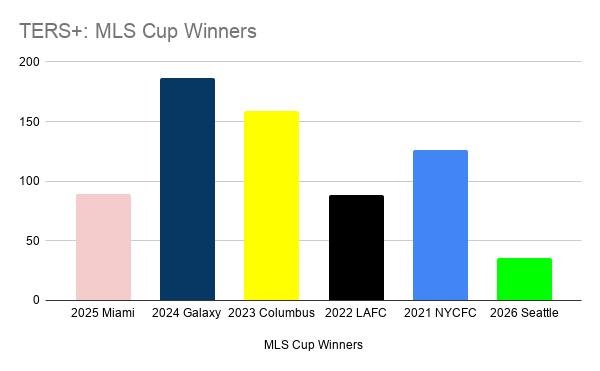
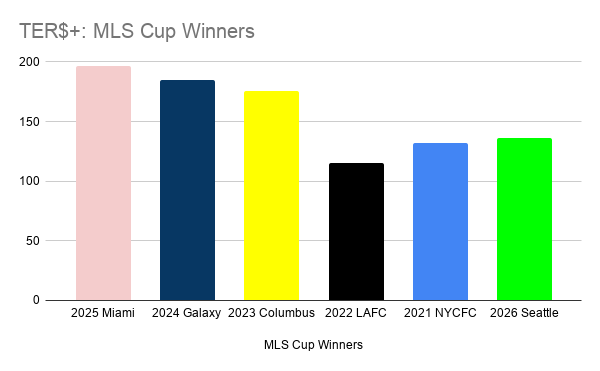
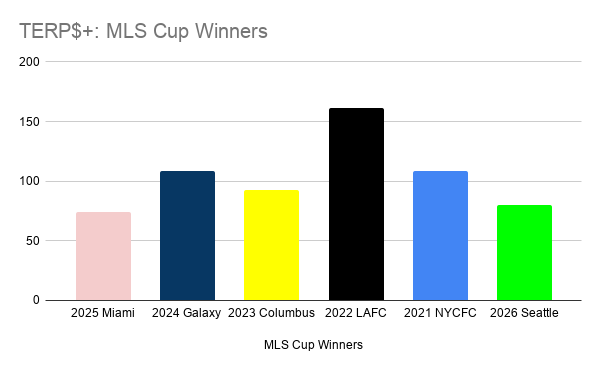
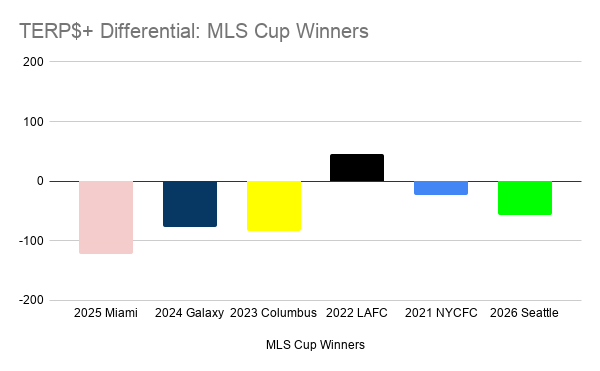
MLS Cup winners tend to have around the league average stability or better, have their best players available more often than not, pick up around-the-league average points relative to their stability and quality, and most often should have been expected to perform better than they did in the regular season.
Based on what we know, this definitely makes sense. Almost every MLS Cup winning team tends to have some of the best talent in the league: Leo Messi, Pec and Paintsil and Puig, Cucho and Nagbe, Bale and Bouanga, Maxi and Taty. Every one of those names is instantly recognizable to MLS fans.
The important part about knockout matches: More often than not, as long as you get into the playoffs — usually meaning you have at least league-average talent and league-average stability — and have some overwhelming talent at your disposal, you’re going to have a better chance than those who don’t at winning knockout games. Not to say upsets don’t happen: 2025 Minnesota and 2024 Atlanta would like a word, but exceptions don’t make a rule.
What's the exception?
Truthfully, the only real exception to the rules here is 2022 LAFC on TERP$+ and TERP$+ Differential. Most MLS Cup winners tend to perform around league average on TERP$+ (that is, being average relative to stability, quality and points earned), and end a little below average on TERP$+ Differential (probably should have performed better based on their quality and stability relative to the league).
These make sense — most tournament-winning teams have high-quality talent but aren’t built for the rigors of winning the Supporters’ Shield, and probably don’t have luck going their way in almost every result — another requirement in a league built on parity to generate season-long success.
LAFC bucked this trend by winning the Shield/Cup double — being built for the long run via their depth, keeping their lineups pretty healthy, and having plenty of star-studded talent to put luck on their side to win knockout matches. I don’t have the data available, but I’d suspect a team like 2017 TFC would look closer to this LAFC team than other MLS Cup winners statistically.
Who Wins the 2026 MLS Cup?
I’m not in the predictions business and absolutely don’t stand by this… Just for fun, let's take a quick look at our bounds and figure out who lies within range of MLS Cup winners from the last 5 seasons.
TERS+: More than a score of 85 (Lowest: 2022 LAFC, 88.8)
TER$+: More than a score of 115 (Lowest: 2022 LAFC, 115.6)
TERP$+: More than a score of 70 (Lowest: 2025 Miami, 74.2)
TERP$+ Differential: More than -125, less than 50 (Lowest: 2025 Miami, -122.7 and Highest: 2022 LAFC, 45.7)
With these bounds, there are six teams whose 2026 values fit inside the bounds of three of the four categories: Houston, Miami, LAFC, Nashville, New England, and Seattle.
You might be asking: Are there any that fit inside all four?... Yes. That would be Chicago and Charlotte.
Both are considered teams with top-end talent (Zinkernagel, Lewandowski, Elliot and Saint-Maximin, Biel) and that performed well, but likely under their true potential... both things that fit the bill for squads that win MLS Cup.
I'd be a bit shocked if either did win, but I think it's pretty safe to say that one of the eight sides fitting at least three of the statistical bounds hoists MLS Cup this year. Time will tell.