Mark Bronnik’s path to professional football has been a winding one, criss-crossing the country before finding himself in the Pacific Northwest with Tacoma Defiance. It seems certain that the next step on that path, whether that’s in the next few weeks or months, will take him to the Seattle Sounders’ first team following an explosive first season in MLS Next Pro with Defiance.
The club has made a habit of promoting players who perform with the second team as they’ve fostered one of the most productive development pipelines in Major League Soccer, but the attacking players who’ve made that same move have seldom seen their performances translate with the jump in level. Bronnik and the Sounders will hope that he can buck that trend when he eventually makes the move himself, and there’s reason to think he can be the one to do it.
Bronnik was the third name on the list when a collection of our writers put together a piece ranking the top prospects coming through Seattle’s development system, and it’s not difficult to see why. He leads Defiance in Goals Added and Expected Goals, consistently sitting near the top of American Soccer Analysis’ round-up of the league’s leaders for those stats.
MLSNP Goals Added (g+) and xG Leaders ⬇️ (as of: 2026-09-07) 🤖⚽️ | #mlsnp
— American Soccer Analysis (@americansocceranalysis.com) September 7, 2026 at 12:45 PM
[image or embed]
From a raw production perspective, he’s having one of the best seasons in Defiance history. Osaze De Rosario and Yu Tsukanome are two of the most recent players to travel this particular path, parlaying a pair of excellent seasons in 2025 into MLS contracts, and the fact that both played primarily as strikers during their peaks for Defiance provides a valuable point of comparison. De Rosario, who just went on loan to join Danish club Sønderjyske Fodbold, only played 12 MLS Next Pro games last season as his performances helped him force his way into a contributing role with the first team. The highlight was undoubtedly the Leagues Cup final where he scored what turned out to be the championship-winning goal, one of the five first-team goals he scored last year.
According to ASA — who capture stoppage-time minutes and provide per-96 minute stats to better reflect the actual playing time in games — De Rosario played 919 MLSNP minutes in those 12 games and scored 10 goals at a rate of 0.94 goals/96. He managed that while averaging 0.74 xG/96 and 0.07 xA/96, putting him at 0.81 xG+xA for every 96 minutes. He combined his large frame and physicality with an ability to read the game that allowed him to be a dominant presence with Defiance. While he’s shown flashes of that dominant presence in a Sounders jersey, he also struggled to have the same impact or finishing touch despite contributing in other areas this season. Of note, he did score an absolutely remarkable goal in his Sønderjyske debut.
Tsukanome set an organization record when he scored 21 goals across all competitions last year, which included three U.S. Open Cup goals. The real standout for Tsukanome was his productivity in MLSNP where he had 18 goals and 5 primary assists while playing 2,257 minutes across 28 appearances, good for a per-96 rate of 0.72 goals and 0.21 assists every 96 minutes from 0.4 xG and 0.16 xA. That represents a pretty stark over-performance on the expected production, with 0.93 actual goal contributions per 96 compared to 0.56 xG+xA. Maybe that over-performance was always going to presage a difficult transition to the first team, but Tsukanome’s role with Defiance also wasn’t one that was likely to exist with the Sounders.
While he did play a significant chunk of the season as the primary focal point in the Defiance attack, he wasn’t likely to get much of a shot there with the Sounders and the team wasn’t likely to give him a run in place of either Jesús Ferreira or Albert Rusnák as one of the dual-10s which is essentially where he operated the rest of the time with Defiance. As a result he never played a minute for the first team before going on loan to USL Championship side Pittsburgh Riverhounds. He has yet to score or assist in 274 minutes with the Riverhounds.
Bronnik isn’t going to reach Tsukanome’s volume of goal contributions with just two regular season games remaining for Defiance, and he’s probably not quite going to get to De Rosario’s per-96 rate for goals, but his productivity speaks for itself. In 23 matches, he’s played 1,523 minutes, scored 13 goals and added 4 assists. That’s 0.76 goals and 0.25 assists per 96 minutes, and 1.01 goal contributions per 96, clearing both individual rates for Tsukanome’s 2025 and De Rosario’s combined goal contributions rate from that same season. Those actual goal contributions have come from 0.69 xG and 0.17 xA per 96 for 0.86 xG+xA, 0.05 expected goal contributions better than De Rosario and 0.3 better than Yu Tsukanome’s.
Part of the positivity about Bronnik’s potential comes from how he goes about putting up those numbers. He’s averaging 4.18 shots and 0.69 xG per 96, meaning that his average shot value is about 0.21 xG, which suggests that he’s consistently finding quality shots and converting them at a seemingly sustainable rate. His average shot value is the best of the bunch (0.18 xG per shot for De Rosario and 0.17 xG per shot for Yu Tsukanome), and he pairs that with the best chance creation as well. His 0.17 xA/96 comes in part from producing 1.01 key passes per 96 compared to 0.21 for DeRo and 0.89 for Yu Tsukanome.
It’s fair to argue that Bronnik’s game is simply more rounded, in part as a result of his time in varied development setups from the Red Bull New York academy and Barca’s Arizona residency to Union Omaha and now the Sounders organization. He’s learned, adapted to and thrived in several different game models and styles, and has also shown more genuine positional flexibility as he’s capable of playing both as a No. 9 or on the wing as more of a wide forward, giving him a variety of paths to first-team minutes.
The question of how players will translate from MLSNP to MLS is a popular one, as teams, pundits and fans are all seeing that players who succeed at the lower levels — particularly strikers and certain types of attacking players — can be genuine options to contribute at a higher level. Just how that success translates is a little trickier than the eye test might suggest, and so ASA set about trying to quantify that exact thing in a recent piece. Their process particularly liked Bronnik’s game, and rated him as currently being effectively a league-average MLS striker, with a +0.01 Goals Added above the average MLS striker per 96 minutes.
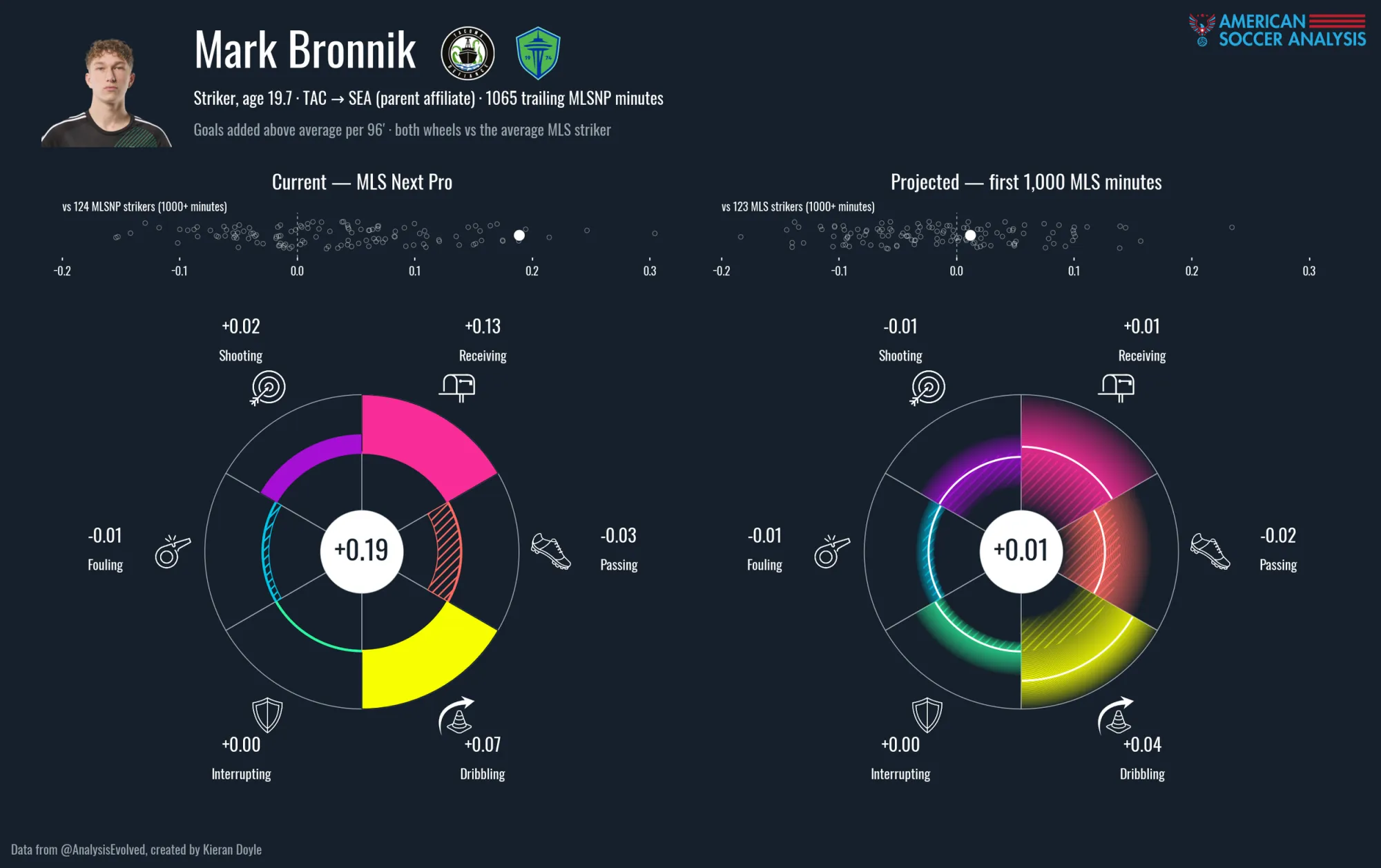
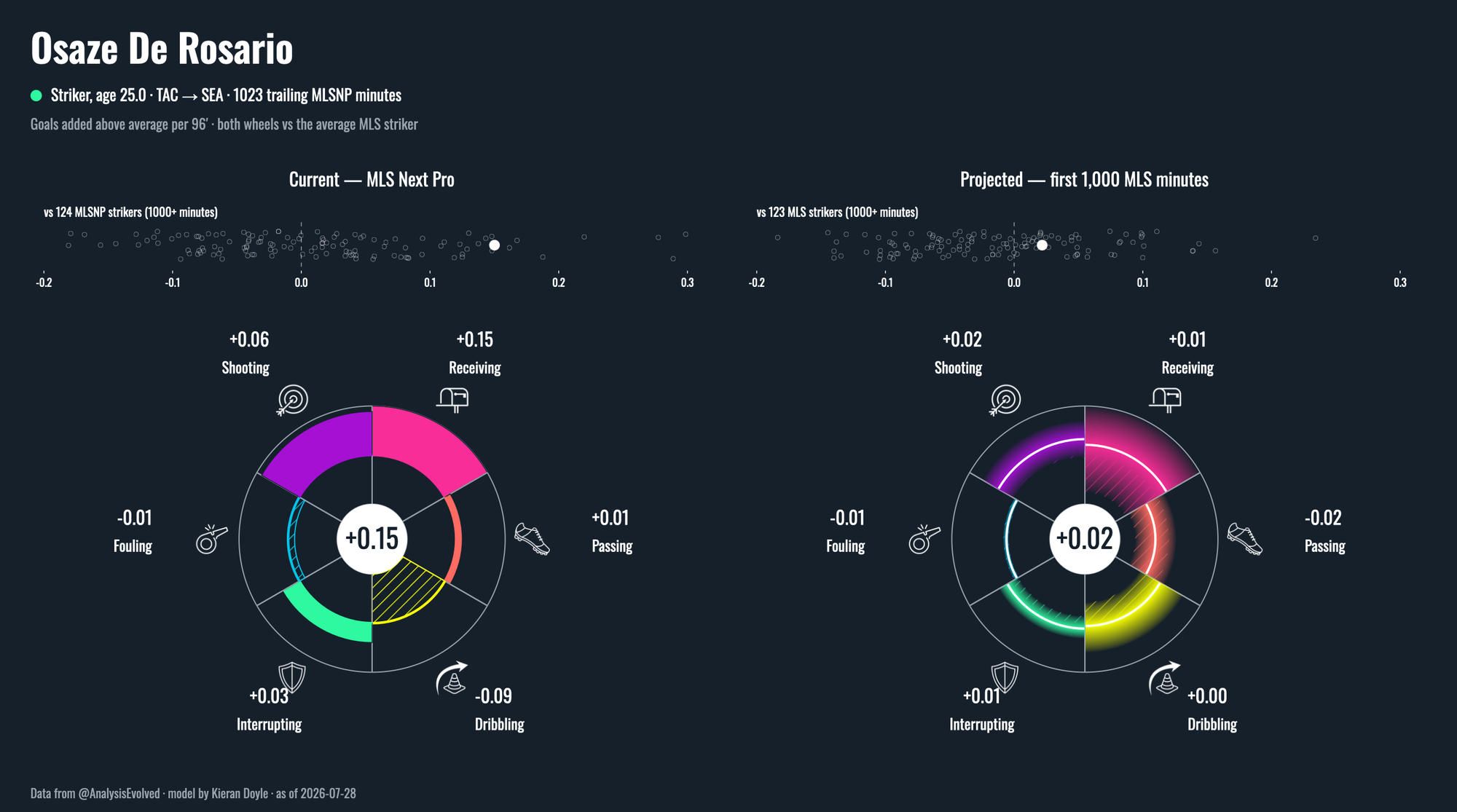
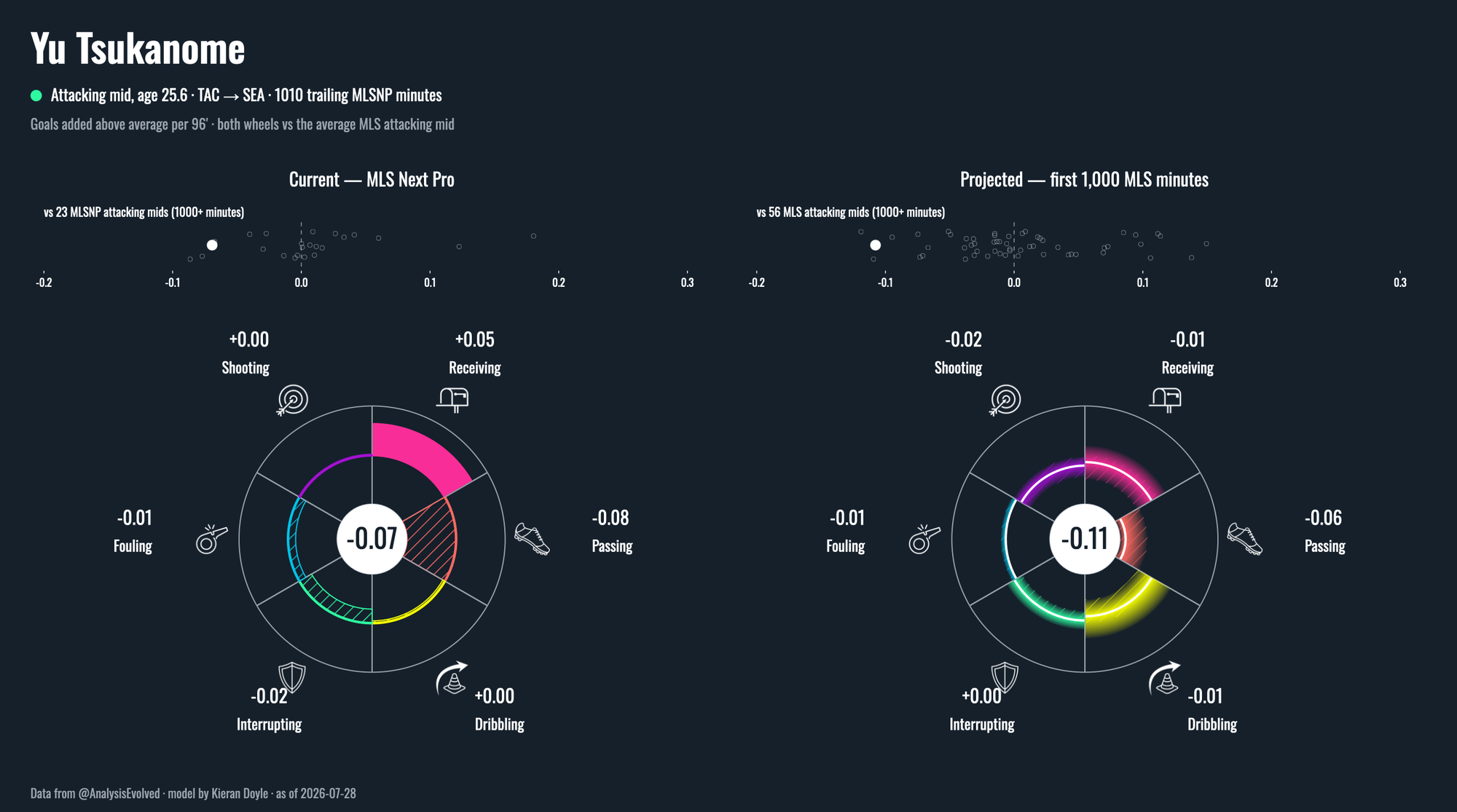
Graphics courtesy of American Soccer Analysis
As you can see, De Rosario earns a slightly better rating at +0.02, but that also raises one of the key differences between Bronnik and the other two players in question — and frankly most of the other players who have made the same step from Defiance to the Sounders with varying degrees of success. Bronnik is just 19, and will turn 20 in November. In the above graphs he’s being compared to two players who are at least five years older. While players can continue to grow and adapt, build new skills and hone old ones, the reality is that by the time both of these players signed MLS deals, they were essentially the players they were going to become. Bronnik is still young enough to be a prospect with more than a little bit of room to grow, improve and mature. You don’t have to look any further than how he started with either Union Omaha or Defiance and how he improved in his time at either club.
Bronnik arrived in Nebraska on an academy contract and provided a goal and an assist in 11 all-competitions appearances as he helped Omaha claim the USL League 1 double, claiming both the Players’ Shield and championship as well as making runs in the USL Cup and U.S. Open Cup at the age of 17. The following year as an 18-year-old, he had 6 goals in 28 games as he earned the League 1 Young Player of the Year and his move to Defiance for a fee that was undisclosed but described as “significant” at the time of the move. With Defiance he scored on his debut, but then struggled to find his scoring touch as he went 8 games without a goal or assist before discovering his current form. After fighting and scrapping, contributing in ways that didn’t necessarily show up on the score sheet and adapting to his new home and team, he’s now contributed 12 goals and 4 assists in the past 14 games. He’s only failed to contribute to a goal in three of those games, and only played 7 minutes in one of them as he came on late to help see out a 1–0 win over Ventura County FC.
The ability to learn and adapt is crucial for the growth of a young player, and Bronnik has already demonstrated both the willingness to do the work necessary and the ability to apply those lessons is a great sign. His age is something of a departure for a player not from the academy system for the Sounders — even guys like Georgi Minoungou and Sam Adeniran were 22 and 23 when they signed their MLS deals — which provides some increased hope for his ability to grow into more than a depth piece as he continues his development. With Dejan Joveljić’s signing, the Sounders are likely set for their starting striker for the next few years, but the sprint season will provide an excellent opportunity to start incorporating Bronnik and with any luck the Sounders could already have the heir to that position in-house.