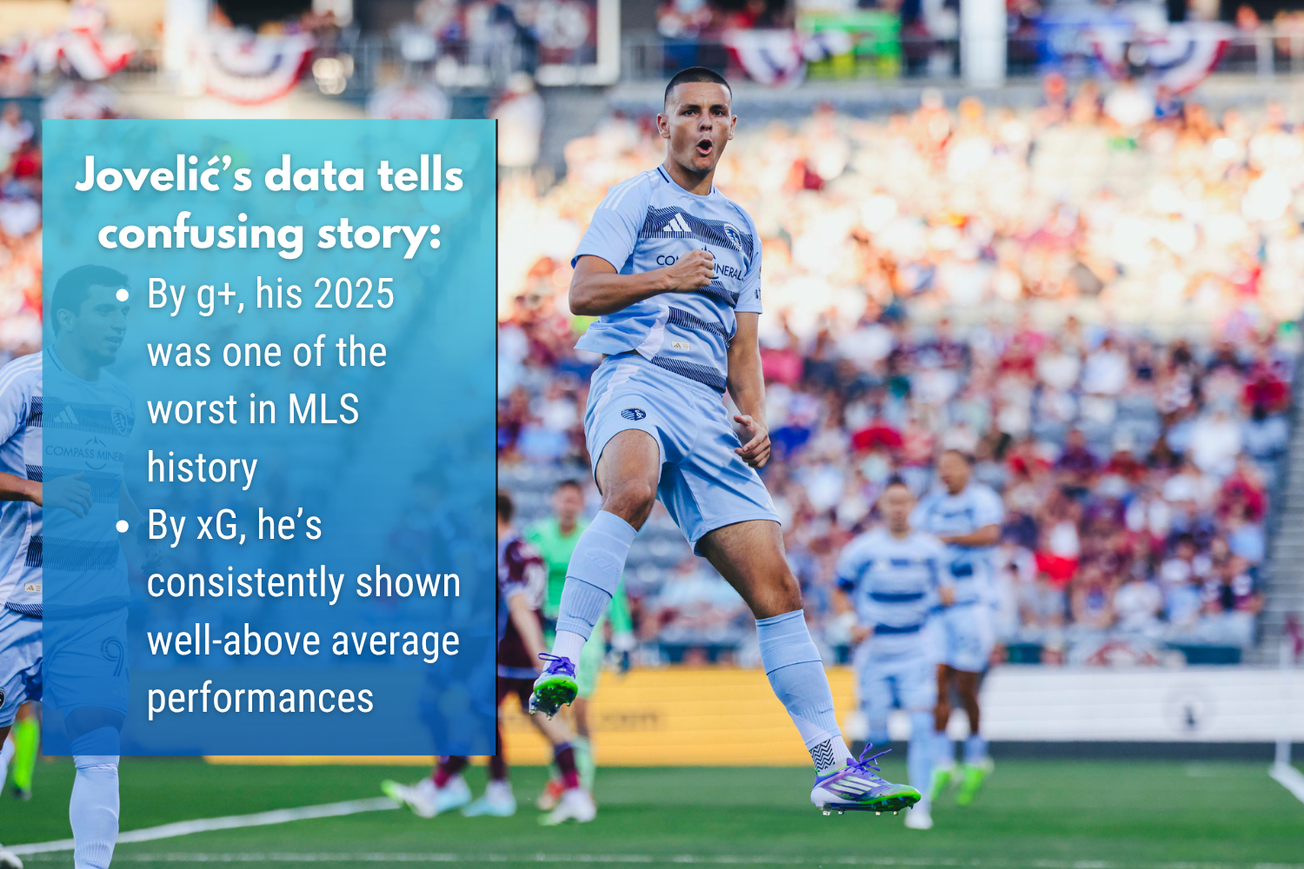
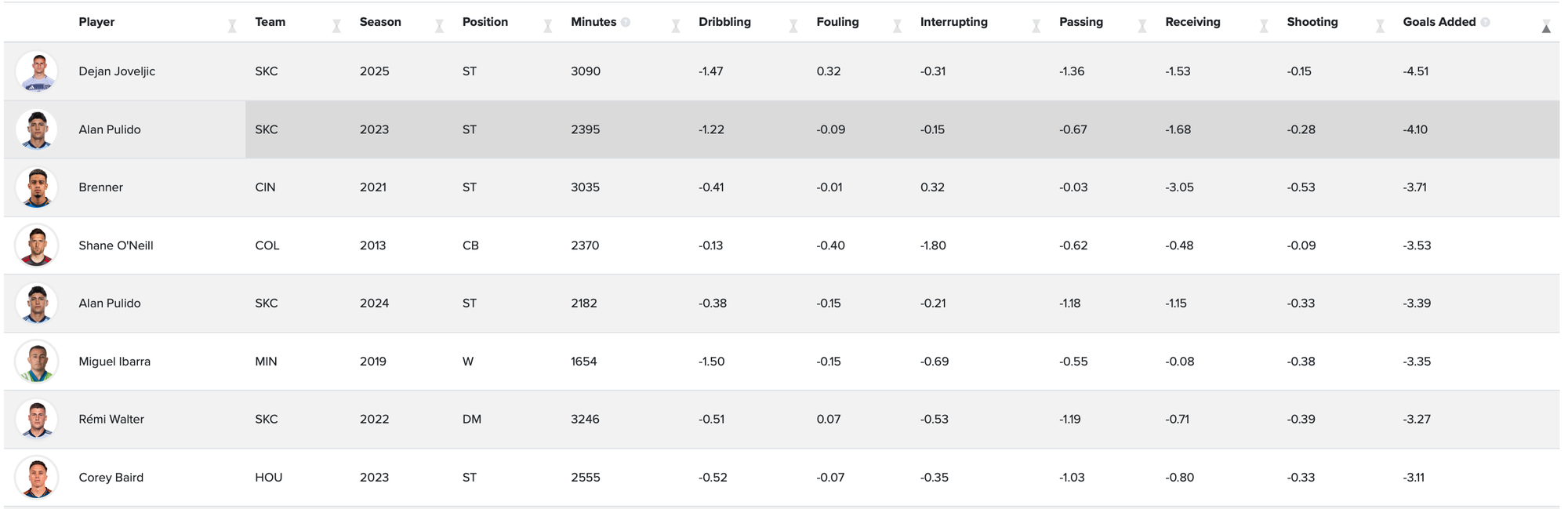
Seattle has completed the signing of Serbian striker Dejan Joveljić from Sporting Kansas City. With 70 all-competition goals, Joveljić has been among the most productive strikers in MLS in his 5.5 seasons. But a look at American Soccer Analysis’ goals added (g+) metric will tell you a very different story. According to g+, Joveljić put up the worst season in MLS history last season. That’s despite scoring 18 goals — for an abysmal team, no less. What is going on here?
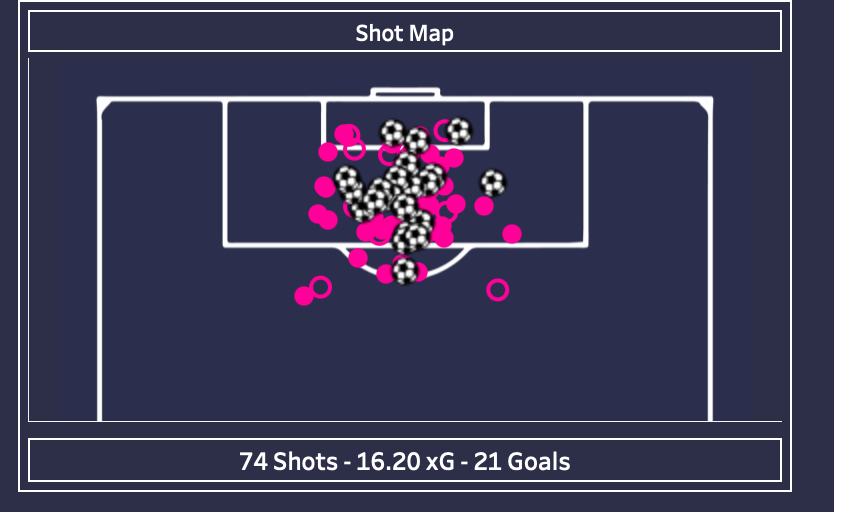
I’m going to spoil the gist of this essay for you: whatever the numbers say, Joveljić isn’t the worst player in MLS history. He’s actually pretty good! So why the confusion? Counting stats and metrics like expected goals make Joveljić look fantastic. Advanced possession models make him look like a dud.
The poor rating Joveljić has received from goals added and other advanced possession models gives us a unique chance to separate the signal from the noise within these models. It can also clue us in on how the Sounders should optimize their new Designated Player.
The Noise
Both g+ and Futi use possession-value models. They rate players from all positions on a single metric, capturing and recording all their in-game actions. Using this data, they measure how much more or less likely their team is to score or be scored upon after a player has performed a particular action. Essentially, these models understand the game as a group of individual players trying to move the ball from risky parts of the pitch — places where they might give up a goal — to areas they’re more likely to score. Idealism aside, that’s a pretty useful way to see the game. These models have proven effective at rating teams as a whole. That said, there are quirks to how possession-value models are built. These quirks can manifest as biases toward and against certain types of players.
Firstly — and I’m sure a lot of you noticed this issue right away — these models rate individual players. G+ tries to quantify each player's contribution to their team scoring goals or being scored upon. While this metric is very useful, soccer is an extremely team-driven game, and no player is fully separate from their teammates (i.e., this is not baseball). The hook of this article is a bit misleading; g+ doesn’t think Jovejic is the worst player in the history of the league for his entire stay in Major League Soccer. It is impossible to fully separate players from their teams, and according to goals added differential, that 2025 SKC team was among the worst in league history. Joveljić has never been a g+ darling, but he put up respectable numbers in his title-winning run with the LA Galaxy just the year prior. So how does that happen? There are two key phrases in that metric that help us understand why Dejan ranks so poorly: “Total” and “Above Average”.
Total is the amount of g+ that a player produced over the course of the entire season, not adjusted by how much that player actually played. Part of Joveljić’s record-low g+ for the season was that he played a very high 3,070 minutes in MLS for an exceptionally bad team. By this metric, he is essentially being marked down for being healthy while playing for an all-time awful team. I am sure most Sounders fans can agree right now that availability has a quality all its own, and that players should not be punished for playing more.
Luckily, we can also look at goals added in terms of how much each player played to account for this. When we do that, we see that Joveljić doesn’t even rank as the worst SKC striker by g+ this decade. Among players who played at least 1,000 minutes in a season, Alan Pulido ranked worse per 96 minutes two times. However, Joveljić’s 2025 season still ranks among the 30 worst all time by g+ Above Average per 96. Why? Well in part because of our other key phrase: Above Average.
Goals added ranks all players by the same unit: net goals for their team. It’s in the name! However, it doesn’t rank them on the same scale. The nature of the model means that some positions are inherently more valuable than others.
Generally, the closer you are to goal, the better when it comes to goals added. In order to rank different positions against one another, goals added compares players against the average rating of players in their position. If that's the case, we can see part of why g+ ranked him so poorly last year. All we need to do is compare him to himself before he transferred to Kansas City. When he moved to a much worse Sporting Kansas City team, he responded by dropping deeper to get on the ball more. He took on more of the all-around attacking responsibility for his team. When Joveljić was in Los Angeles, playing on a great team, his usage rate in the final third was 18.94% above average for his position, but after moving that dropped to 14.21%. The difference can be clearly illustrated by comparing the heat map from his championship campaign on the Galaxy to his 2025 season in Kansas.
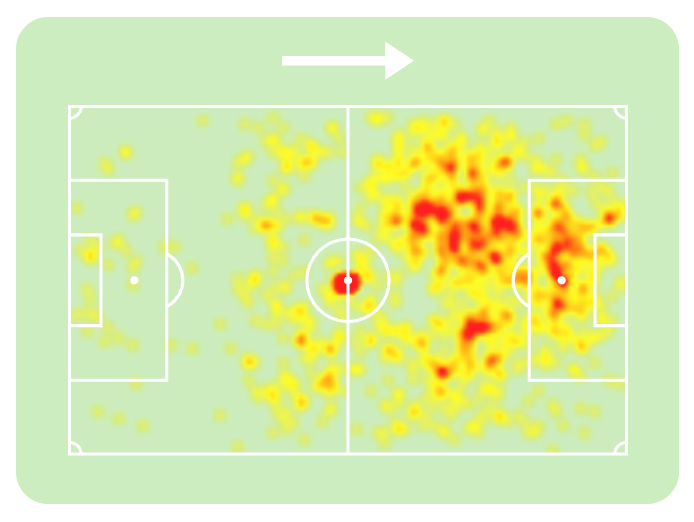
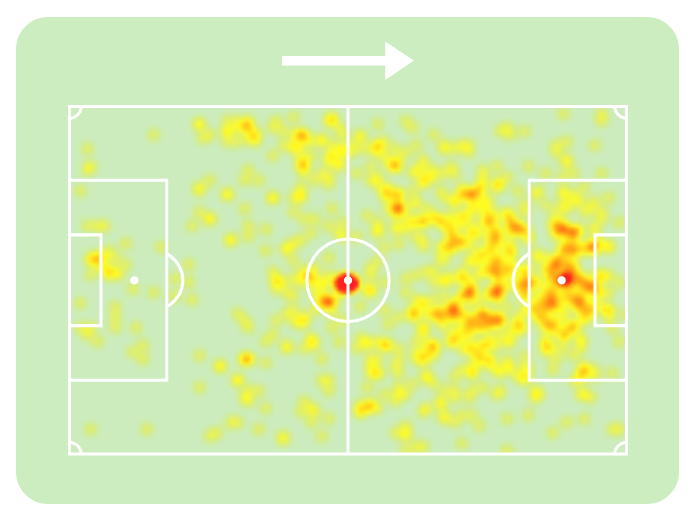
Jovelić’s 2025 heat map (left) vs. 2024 with Galaxy (right)
In Los Angeles, the team around him was good enough that he could stay in the box and focus on scoring goals. Moving farther away from the goal to drop into midfield, Joveljić is moving out of the parts of the pitch g+ rates most highly, and into less valuable regions, producing less raw goals added per action on average. However, because g+ compares him to an average striker, he is getting compared against every other striker who was able to stay closer to goal.
The Signal
We now have a better understanding of goals-added’s weaknesses that led it to ranking Joveljić’s 2025 season so poorly, but that doesn’t mean we should disregard g+ entirely. Goals added is still a very useful metric. It’s telling us real information about Joveljić as a player and how he is best deployed.