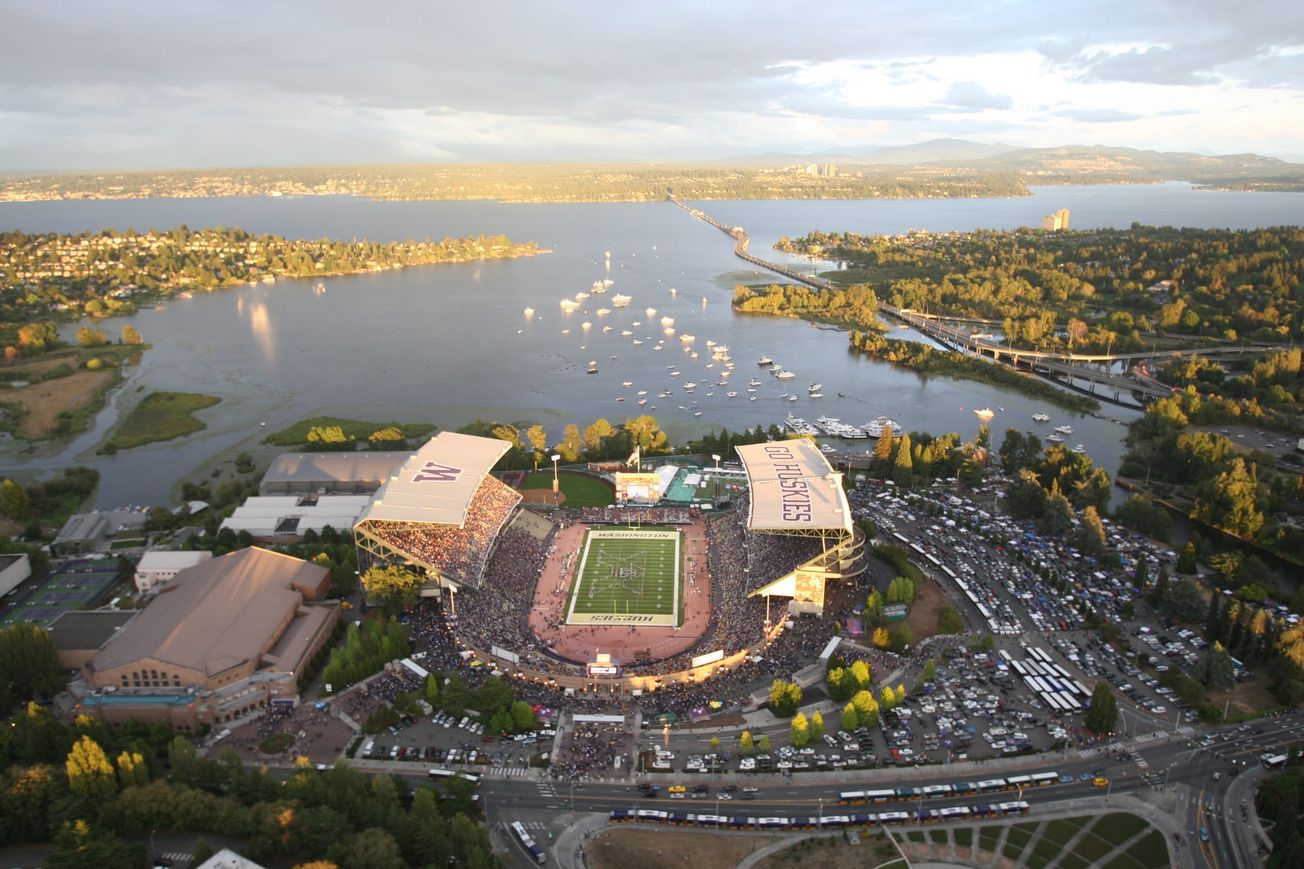
With idyllic surroundings on the shores of Lake Washington, it has long been known as The Greatest Setting in College Football. But Husky Stadium’s catch phrase could’ve been much, much more.
If only the University of Washington leadership had shared the vision of something far greater, an opportunity of truly global proportions a generation ago, this cauldron of sporting sound with extended views of gleaming snowcapped volcanoes, glittering waters, and an iconic downtown skyline – all at the intersection of festive tailgating en masse and sail-gating for a more select crowd – this might also lay claim to The Greatest Setting in World Football.
Twice before Seattle had staged world fairs which dramatically raised its global profile. In 1994, the city was presented with an opportunity to bring us a portion of the globe’s grandest sporting event. In case you were wondering, it whiffed. Nevertheless, over the past generation the region got its act together and is now poised to put on six 2026 FIFA World Cup matches.

This article originally appeared in IV: The Sounder at Heart magazine. Issue 2 focuses on Seattle’s role in the 2026 Men’s World Cup. It features columns by Garth Lagerwey and Leander Schaerlaeckens; a look back at Seattle’s failed attempt to get into the 1994 World Cup bid; an accounting of the USMNT’s future-altering trip to Seattle in 2013; a profile of Ballard’s two grassroot teams; an inside accounting of the RAVE Foundation’s populate the state with mini-pitches; and so much more. Issues remain available.
Why Not Us?
Only a few folks are around to share the tale of when Seattle squandered its first chance to host a set of World Cup matches. In many respects, USA 1994 did just fine without the Emerald City, setting attendance records which still stand. Locals grumbled for a bit but then got on with it, mapping out flights and highways to witness history in other locales, most namely Palo Alto and Pasadena, Calif..
Yes, it was two other Pac-12 cathedrals that welcomed the world while Seattle took a breather. Together, old Stanford Stadium and the Rose Bowl hosted a combined total of 14 matches in a tournament half the size of this summer’s quadrennial. Most of those contests were conducted before huge crowds. Average attendance was more than 82,000, compared to 69,174 for the tournament. Yet most travelogues of those afternoon affairs would complain of participants and spectators, alike, wilting under a sweltering sun.
Seattle women’s soccer pioneer Bernadette Noonan was flown back to Giants Stadium, to be honored along with other impactful immigrants before a ’94 World Cup match.
“I could never understand why (Seattle) couldn’t get that World Cup,” Noonan lamented a few years ago. “We had the governor and the University of Washington. We should’ve gotten it.”
Up in Puget Sound, the playing conditions were far more favorable: temperatures mostly fluctuating between 65 and 80, with low humidity and, of course, the occasional dose of liquid sunshine. Just imagine a match day at Husky Stadium, the natural beauty constantly vying with on-field activity for your attention.
“We look like bozos”
That was the promise of 1994, for a handful of games to be played on Montlake in what proved to be the breakthrough event in establishing soccer’s foothold in this country. While some found it unfathomable that the U.S. organizing committee would bypass Seattle, others could readily detect the holes in the bid. The most cynical would conclude it never stood a chance, that it was DOA.
Upon learning Husky Stadium was not chosen, the executive director of the Seattle Host Committee, Dick Angell, summed it up this way: The local soccer community, “went out of its way to make an effort, and now we look like bozos.”
In the beginning, there was supreme optimism. On Independence Day 1988, hours after FIFA voted to award the tournament to the U.S., local media flocked to a gathering of local coaches and players from FC Seattle and local colleges. U.S. Soccer spokesman Jim Trecker phoned in from Zurich to say, “FIFA was extremely impressed with Husky Stadium, and there’s a very good chance (tournament matches) will be played there.”
Unlikely Flagbearers
At the time, semipro FC Seattle was, by default, the sport’s flagbearer. Bud Greer, the club owner, had funded teams for men, women and a city league for youth. The NASL Sounders had folded five years earlier. Four days after the World Cup announcement, the Tacoma Stars would close shop, despite averaging more than 10,000 in attendance (new owners would re-float the MISL indoor franchise weeks later).
Suffice to say, those were hard times for soccer, locally and nationally. A key piece of the U.S. bid was to promise development of a new Division 1 league. That was manifested in Major League Soccer, albeit not until 1996.
Greer soon formed a sports promotion company, Alistar Sports, and Angell was hired for a lead role in Seattle bidding for both the World Cup and the 1992 U.S. Olympic track & field trials, also pegged for Husky Stadium. In July 1990, Angell said Seattle had been encouraged to bid for the tournament’s first match and opening ceremonies. Quarterfinals and semifinals were also being considered. “Except for the fact that the field is AstroTurf, Husky Stadium is a perfect place for soccer,” Angell said.
For footy fans, optimism reigned. But in the corridors of power, the response was tepid and turned colder with each passing month, leading up to the final venue determination date of March 22, 1992. Effectively, The Establishment said, get off our lawn.
Soccer obviously lacked cachet and connections to those in the local C-suite. However, there was more to it, their indifference to welcoming the world to our doorstep. During the 1980s, there was universal backing of two NCAA Final Fours and the NBA All-Star Game coming to the Kingdome. But sports promoter Bob Walsh, the leader of those successful bids, then took a mighty step too far, alienating key decision makers.